Shiga Kogen, Japan: Family Ski Guide
18 mountains, one pass, age 4 starts here.
Last updated: June 2026
Japan
Shiga Kogen
Book Shiga Kogen if you're a family that treats the trip as an adventure, not just a ski holiday. The scale rewards returning families and mixed-ability groups better than any other resort in Japan, your teen can chase steeps at Yakebitaiyama while your four-year-old rides the conveyor belt at Okushiga, all on one pass. Skip it if your children are under four and you need compact walkability, or if the idea of planning a Shinkansen-to-bus transfer with jet-lagged kids makes you feel ill rather than excited. Booking sequence: Book English-language ski school first (Ride-Shiga or SISS fill quickly in peak weeks), then accommodation at Prince Hotel East or Okushiga, then flights to Tokyo. Budget 90 minutes of planning after the kids are asleep, that's in fact all it takes once you know the order.
Is Shiga Kogen Good for Families?
Shiga Kogen is the best resort in Japan for families who plan to return, 18+ interconnected mountains on a single lift pass, with 40% beginner terrain and ski school from age four, give you a system your children won't outgrow in a decade.
The catch is real: this is a sprawling, spread-out resort where navigating between sub-areas requires bus rides, Japanese signage, and more logistical effort than a compact Alpine village. Families who thrive on planning will love it.
¥216,000–¥288,000
/week for family of 4
You need a guaranteed English-language crèche for under-threes
Biggest tradeoff
What's the Skiing Like for Families?
Your four-year-old can be skiing here by day two. Shiga Kogen's beginner infrastructure is built for progression, not just containment, and with 40% of the terrain graded easy across 18+ linked areas, your child won't be doing the same run all week.
The starting point for most families is Okushiga Kogen where the Kids' School (ages 4-12) uses a conveyor belt lift and the purpose-built Chibikko Forest Course a gentle, tree-lined trail designed specifically for children making their first lift-served runs. It's the kind of thoughtful design that makes a nervous five-year-old feel like an explorer rather than a student.
For toddlers not yet ready for skis, Maruike Snowland offers a moving sidewalk, sled rentals, and a contained play area that buys parents a genuine morning of skiing.
The progression path looks like this:
- Day 1-2: Conveyor belt and pizza-stop turns at Okushiga or Maruike, flat, wide, forgiving snow
- Day 3: First chairlift ride on Okushiga's gentle greens, possibly via the Chibikko Forest Course
- Day 4-5: Ichinose Family Area's wider, longer greens, a meaningful step up in distance without steepness
- Return trip (next year): First blues at Ichinose Diamond, then the long cruisers off Gondola No. 2 from Prince Hotel East
- Main friction point: Moving between sub-areas mid-lesson isn't practical. Pick one base area per day and commit to it.
Critical for international families: resort-operated schools at Okushiga and Maruike teach in Japanese. Always book one of the three English-language providers:
- SISS (Shiga International Ski School): Full-day kids group lesson ¥15,800, includes lift pass and lunch, max 6 children per group. The best value bundle on the mountain.
- Ride-Shiga: Strong recent reviews from international families. A January 2025 Australian parent reported their 7-year-old went from zero to stopping and turning in a single 3-hour session, "several meltdowns" included. They also offer hotel pickup from Yudanaka and Shibu Onsen.
- Canyons Shiga Kogen: Accepts skiers from age 3 (snowboarders from 6), the youngest entry point at the resort. Private lessons available.
Returning families with older kids will find real depth here. Teens ready for steeper terrain can push into Yakebitaiyama and Terakoya while younger siblings stay on the Ichinose greens, and everyone rides the same lift pass. Writers at Powder Family Japan have been returning since the early 2000s and say they still discover new runs.
Trail Map
Full CoverageTerrain by Difficulty
Based on 14 classified runs out of 16 total
© OpenStreetMap contributors, ODbL
📊The Numbers
| Metric | Value |
|---|---|
Family Score | 6.9Good |
Best Age Range | 4–15 |
Kid-Friendly Terrain | 40%Above average |
Ski School Min Age | 4 years † |
Kids Ski Free | — |
Local Terrain | 16 |
Score Breakdown
Value for Money
Convenience
Things to Do
Parent Experience
Childcare & Learning
Planning Your Trip
🏠Where Should Your Family Stay?
Book Prince Hotel East if you have children under seven, the ski-in/ski-out access to Gondola No. 2 eliminates the morning gear-and-bus scramble that breaks young families at sprawling resorts.
- Best for convenience, Prince Hotel East (from ~¥28,000/night): Direct slope access, panoramic views, and a strong intermediate position as your daily hub. Advanced skiers lap Gondola No. 2 while younger children use the gentle runs below. Powder Family Japan specifically recommends it for families with young kids. The tradeoff: dining options are hotel-bound, and the atmosphere is functional rather than charming.
- Best for atmosphere, Ichinose village lodges (from ~¥15,000/night): Walkable restaurants, a more locally authentic village feel, and lower nightly rates. Slope access is slightly less direct but still manageable. Ideal for annual families whose kids can carry their own gear.
- Best for youngest children, Okushiga area (from ~¥18,000/night): Closest to the Kids' School, Chibikko Forest Course, and the gentlest terrain. Powder Family Japan moved here from Ichinose specifically when their children were small. Limited evening dining, you'll eat at your hotel.
Budget note: Many properties are traditional ryokan or hotel-ryokan hybrids where breakfast and dinner are included in the nightly rate. Factor this into your cost comparison, a ¥15,000/night half-board ryokan may be cheaper than a ¥12,000 hotel plus two restaurant meals.
💬What Do Other Parents Think?
Parents who've skied Shiga Kogen with their families tend to split into two groups: those who tried it once and those who return year after year. The repeat visitors are the vocal ones, and their enthusiasm centers on a few consistent themes.
You'll hear families praise the sheer scale of the terrain.The 18 interconnected areas mean a first-timer and a confident teenager can both find appropriate terrain without the family fragmenting for the entire day.The complaints are consistent too, and worth hearing before you book. Navigation between the 18 areas confuses families on their first visit, and the English-language signage is minimal outside the main zones.
Several parents mention arriving at a lift only to discover it connects to terrain too advanced for their younger children, with no obvious way back except downloading.
The food situation on-mountain draws mixed reviews: plentiful and affordable, but repetitive if you're staying a full week. Parents who supplemented with packed lunches from their hotel reported higher overall satisfaction than those who relied entirely on mountain restaurants.
Families on the Slopes
(40 photos)Photos from Google Places. Posted by visitors.
How Much Are Lift Tickets?
The single biggest money lever at Shiga Kogen is the SISS full-day kids group lesson at ¥15,800, it includes the lift pass and lunch, which means your child's entire ski day is covered for less than the cost of a separate lesson plus separate pass plus separate meal.
- Pass math: Adult day pass ¥7,500, child ¥4,000. One pass covers all 18+ areas, no add-ons, no zone upgrades, no nickel-and-diming. That's exceptional coverage per yen.
- The SISS bundle: A child's full-day group lesson (¥15,800) replaces a day pass (¥4,000) + lesson (~¥10,000+) + lunch (~¥1,500). You save roughly ¥1,700 and eliminate three separate purchases.
- Reloadable point ticket: If you're skiing fewer than five full days or sticking to one sub-area, the point-based ticket system lets you pay per lift ride, worthwhile for a parent doing half-days while kids are in school.
- Free transport: The shuttle bus between all areas costs nothing. This saves ¥3,000-5,000/day versus taxi transfers that families at multi-base resorts like Hakuba routinely spend.
- Rental on-mountain: Adult equipment ¥4,500/day, child ¥3,000/day. Multi-day discounts may apply, ask at the rental shop on day one.
- Cash reserve: Many smaller ticket offices and restaurants prefer cash. 7-Eleven and Japan Post ATMs accept international cards. Budget ¥20,000-30,000 in cash per family for day-to-day spending.
We have not confirmed whether children under 6 ski free or whether a multi-day family pass exists. Ask at the ticket office on arrival, and if anyone finds out, let us know.
Planning Your Trip
✈️How Do You Get to Shiga Kogen?
The journey is two clean legs: fly into Tokyo, then ride the Shinkansen to Nagano (90 minutes), then take a bus or taxi up to Shiga Kogen (about an hour). Total transit from Narita airport: roughly four hours door to door.
- Best airport: Tokyo Haneda, shorter city transfer to Tokyo Station than Narita, and more domestic connections if arriving via another Japanese city.
- The Shinkansen leg: Reserve seats in advance via SmartEX app or at the station. Children under 6 ride free on an adult's lap; ages 6-11 are half price. The train itself is a highlight, kids love it.
- Nagano to Shiga Kogen: Nagano Dentetsu bus from Nagano Station runs directly to resort stops (~70 minutes, ~¥1,800 adult). Taxi costs roughly ¥15,000 but saves an hour of waiting with tired children.
- No car needed: The free shuttle bus (8:30-17:30 daily) connects all 18+ sub-areas once you're on the mountain. Rent skis up top, not in the valley, and you can fly without bulky equipment.
- Smartest family move: Arrive in Tokyo a day early. A recovery night absorbs jet lag so your four-year-old isn't melting down on day one of ski school. Budget hotels near Tokyo Station start around ¥10,000.
Transit tip: Buy a Suica or Pasmo IC card at the airport on arrival. It works on trains, buses, convenience stores, and vending machines, one card eliminates a hundred small friction moments across the trip.
☕What's There to Do Off the Slopes?
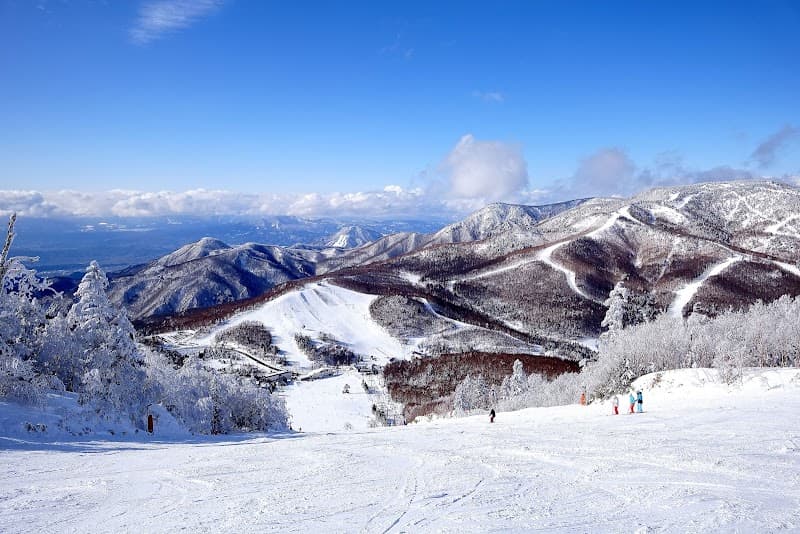
Evenings at Shiga Kogen are quiet, warm, and food-focused, this is not an après-ski resort, and that's the point. You'll eat well, soak in an onsen, and be asleep by 9pm. Your kids will remember it fondly.
- The rest-day experience that defines the trip: Jigokudani Snow Monkey Park about an hour from the resort. Wild Japanese macaques sitting in steaming natural hot springs, snow on their heads, completely unbothered by your children's amazement. The 30-minute forest walk from the car park is manageable for ages 5+ but not pushchair-friendly. Go late morning, the monkeys are most active and the trail is less icy.
- Onsen after skiing: Yudanaka and Shibu Onsen are traditional hot spring towns in the valley below. The experience of soaking in a steaming outdoor bath after a cold ski day is the moment your eight-year-old will describe to their class. Ride-Shiga offers hotel pickup from both towns if you're based there for lessons.
- Evening dining: Ichinose has the best walkable restaurant cluster. Specific restaurant data is limited in English-language sources, but the half-board model at most ryokan means multi-course Japanese dinners, expect grilled fish, rice, miso soup, pickled vegetables, and seasonal dishes served to your room or a communal dining hall. Quality tends to be high even at budget properties. This is Japan.
- Cultural day trip: Nagano city is reachable by bus (~1 hour) for Zenko-ji Temple, a 1,400-year-old Buddhist temple with a famous pitch-black underground passage children find thrilling.
When to Go
Season at a glance — color-coded by family score
Common Questions
Everything families ask about this resort
Have a question we didn't cover? We'd love to add it to our guide.
The Bottom Line
Would we recommend Shiga Kogen?
What It Actually Costs
It is not cheap, but the single all-area lift pass covering 21 resorts and the SISS lesson bundle keep costs more predictable than resorts where you are constantly adding zone upgrades or lesson surcharges.
- Budget family week (5 ski days): Accommodation at ¥15,000/night half-board (includes breakfast and dinner) = ¥105,000. On-mountain daily spend ~¥36,000 × 5 = ¥180,000. Rest day with Snow Monkey Park ~¥8,000. Approximate total: ¥300,000 (~$2,000 USD / ~€1,850) excluding flights and Tokyo overnight. The half-board ryokan model is the key budget lever, it replaces five restaurant dinners.
- Comfort family week: Prince Hotel East at ~¥28,000/night = ¥196,000. On-mountain costs similar. Private lessons for one child add ~¥25,000/day. Approximate total: ¥450,000-500,000 (~$3,000-3,300 USD).
- The real budget threat: International flights to Tokyo, not the resort itself. Book flights 4-6 months ahead; the Shinkansen leg (~¥8,000 adult one-way to Nagano) is fixed-cost and unavoidable.
Exchange rate volatility matters. At ¥150/USD the numbers above hold; at ¥130/USD the trip costs meaningfully more. Check rates when booking, not just when browsing.
Your smartest money move: Book a half-board ryokan to eliminate restaurant dinner costs. The dinner-and-breakfast model saves ¥5,000-8,000/night compared to eating out, and the multi-course meals are a cultural experience in themselves.
The Honest Tradeoffs
Shiga Kogen is not a compact resort. The 18+ sub-areas are spread across a wide mountain system connected by shuttle buses, not by ski runs between every zone. With young children, this means choosing one base area per day and committing to it, spontaneous "let's try that side of the mountain" moments don't happen easily.
Japan travel logistics add a layer of complexity that European or North American resorts don't. The Shinkansen-to-bus transfer, non-English signage, cash-dependent ticket offices, and jet lag adjustment mean your first 24 hours require more patience than most family ski trips.
- Nozawa Onsen: Compact, walkable village with stunning atmosphere, easier to navigate on foot with young kids, though less terrain variety.
- Hakuba Valley: Comparable scale with stronger English-language infrastructure and more international family community, but you'll need a car or paid shuttles between areas.
- Niseko United: The easiest Japan resort for English-speaking families, with the best nightlife and dining, but more crowded, more expensive, and less distinctly Japanese.
Would we recommend Shiga Kogen?
Book Shiga Kogen if you're a family that treats the trip as an adventure, not just a ski holiday. The scale rewards returning families and mixed-ability groups better than any other resort in Japan, your teen can chase steeps at Yakebitaiyama while your four-year-old rides the conveyor belt at Okushiga, all on one pass.
Skip it if your children are under four and you need compact walkability, or if the idea of planning a Shinkansen-to-bus transfer with jet-lagged kids makes you feel ill rather than excited.
Booking sequence: Book English-language ski school first (Ride-Shiga or SISS fill quickly in peak weeks), then accommodation at Prince Hotel East or Okushiga, then flights to Tokyo. Budget 90 minutes of planning after the kids are asleep, that's in fact all it takes once you know the order.
Similar Resorts
Families who loved Shiga Kogen also enjoyed these
Joetsu Kokusai
Tomamu
Nozawa Onsen
Ryuoo
Jackson Hole
Rusutsu
Transparency note: This content was created with AI assistance and reviewed by Tom Meredith, our editor. Prices, dates, and availability may change. We recommend confirming details directly with the resort before booking.