Beitostølen, Norway: Family Ski Guide
One sign planted in 1965. Now 65% beginner terrain, whole family together.
Last updated: June 2026
Norway
Beitostølen
Book a cabin or hotel in Beitostolen village. If you want bigger downhill terrain, Hemsedal is 2 hours away. Trysil is Norway's largest and most family-focused. If cross-country is the priority, Beitostolen is hard to beat in Scandinavia. For a similar outdoor-culture experience, Geilo balances cross-country and downhill well. Book a cabin through Beitostolen.com and buy multi-day passes for per-day savings. The February winterferie week is peak demand, early March offers longer daylight and better rates. The village has a Joker supermarket for basics. Oslo is 3.5 hours by car, and the drive through Valdres valley is scenic but slow.
Is Beitostølen Good for Families?
Beitostolen is Norway's cross-country capital that happens to have a small but solid downhill area. The Jotunheimen mountains surround you, the terrain is beginner-friendly, and the Norwegian emphasis on outdoor kids means the programs are excellent. Less terrain than Trysil or Hemsedal but a stronger cross-country and biathlon culture.
Best for active families who want to ski, snowshoe, and explore rather than lap chairlifts all day.
With 50 runs skewed heavily toward blues and greens, any family member who is a confident intermediate or above will exhaust the mountain's challenge within a day or two.
Biggest tradeoff
What's the Skiing Like for Families?
Today his son Atle manages the resort, and journalists from Ski Safari describe him as visibly proud, smiling through press visits with the enthusiasm of someone who hasn't forgotten that sign.
The resort's own website puts it plainly: "It all started with the Beitostølen ski school so we dare say: we are best at this." Beito Aktiv, the children's ski school, takes snowplay participants from age four and alpine group lessons from age five.
Four-day group courses (90 minutes per day, Monday to Thursday) run during Norwegian school holiday weeks 7, 8, and 9. Private lessons are bookable any day throughout the season, with alpine instruction available from age four and snowboard from age seven.
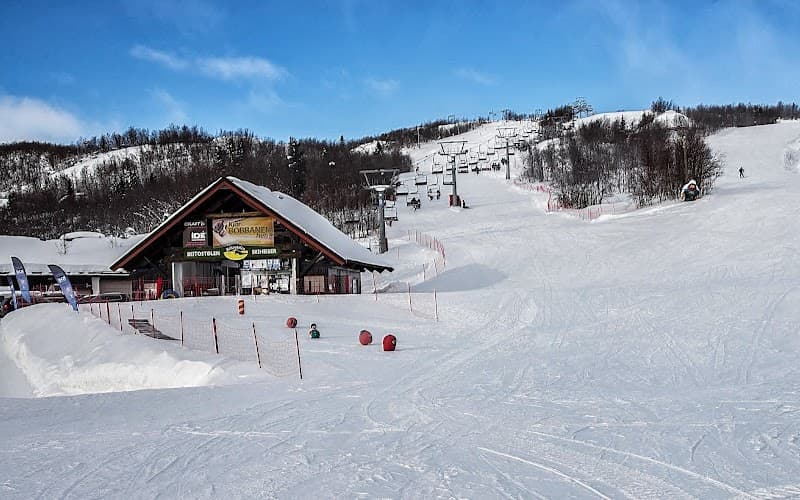
All instructors and children wear helmets on the slope. The school also offers adaptive skiing, sitski, bi-ski, and ski cart, as part of its explicit commitment to making skiing accessible to everyone. The alpine terrain itself is deliberately compact. Seven lifts serve 12 runs, the longest stretching 2.4 km from summit to base with 354 metres of vertical drop.
That sounds small on paper, and it is.
But for families with children under 10, compact means you can see the entire mountain from the base lodge, spot your child on the slope from the terrace, and reach any point on the hill within five minutes.
The green and blue runs are wide, consistently groomed, and share a natural fall line that lets beginners build speed without sudden changes in pitch. A confident five-year-old can ski from the top to the bottom by day three.
The cross-country network, 320 km of groomed trails fanning out from the village, is the real draw for parents who want exercise beyond the alpine area while their child is in ski school.
Trail Map
Full CoverageTerrain by Difficulty
Based on 38 classified runs out of 50 total
© OpenStreetMap contributors, ODbL
📊The Numbers
| Metric | Value |
|---|---|
Family Score | 7.1Good |
Best Age Range | 3–14 |
Kid-Friendly Terrain | 65%Very beginner-friendly |
Ski School Min Age | — |
Kids Ski Free | — |
Magic Carpet | Yes |
Local Terrain | 50 |
Score Breakdown
Value for Money
Convenience
Things to Do
Parent Experience
Childcare & Learning
Planning Your Trip
💬What Do Other Parents Think?
What Parents Love
- Cross-country transformation: Several parents note their children begging to try the Nordic tracks after watching local kids effortlessly glide past, with many families renting gear multiple times during their stay
- Biathlon excitement: Parents report their children becoming obsessed with the shooting range demonstrations, with one family booking an extra day just so their 8-year-old could try the beginner biathlon program
What Parents Flag
- Limited terrain for advanced skiers: Families with strong intermediate or advanced skiers mention feeling restricted after day two on the downhill slopes
- Weather dependence: Parents note that cloudy days can make the mountain feel smaller, and visibility issues are more noticeable on the shorter runs
- Quiet evenings: Some families expect more evening entertainment options, though others appreciate the early bedtimes this naturally encourages
The most common surprise parents mention is watching their children choose cross-country skis over downhill on the final day, racing along the illuminated evening tracks while dinner waits back at the lodge.
Families on the Slopes
(8 photos)Photos from Google Places. Posted by visitors.
🏠Where Should Your Family Stay?
Norwegian cabin culture, hytte, means self-catering in a timber cabin is not the budget compromise here. It is the aspirational local choice. When Norwegian families book Beitostølen, they book a cabin with a kitchen, a wood stove, and a view of snow. International families who do the same are participating in a tradition, not cutting corners.
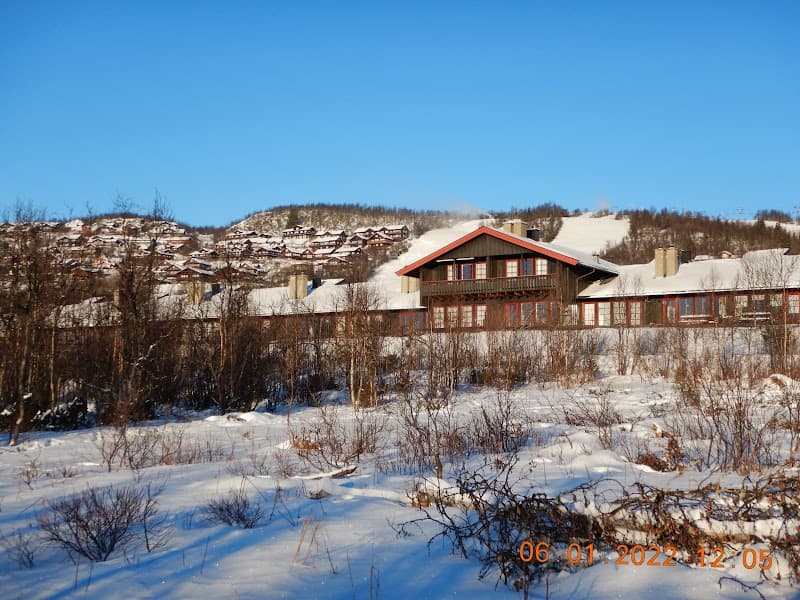
Hovi Cabins connected directly to the resort's founding family, and Bergo Cabins on the hillside above the village are two options that fit this mould. Family travel writers describe the hillside cabins lighting up at dusk "like fireflies" against the snow, a detail that gives you the scale and atmosphere of the setting.Bergo Apartments and Riddertunet Apartments offer self-catering in a more conventional format for families who prefer a flat layout to a cabin.
For families wanting hotel-style service, the Radisson Blu Resort Beitostølen is the most prominent property in the village. Riddergaarden and Gjestegaarden Apartments round out the options.
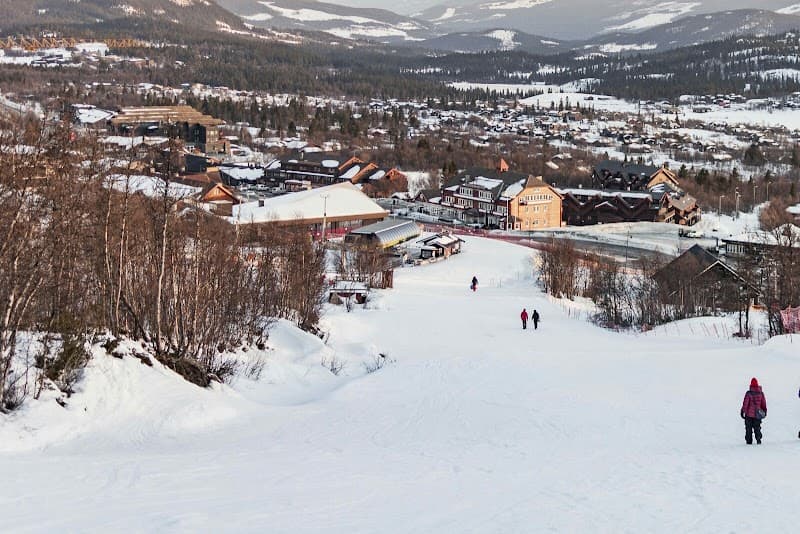
We don't have verified nightly rates or specific family room configurations for any of these properties. The village is compact enough, one main road, slow traffic that stops for pedestrians, that proximity to the lifts is not a meaningful differentiator. Everything is walkable.
Book accommodation early for weeks 7, 8, and 9. Those are Norwegian school holidays and demand peaks sharply.
How Much Are Lift Tickets?
The single lift pass covering both Beitostølen and Raudalen is the foundation of any budget strategy here. At 549 NOK (~€47) per adult day and 439 NOK (~€37) per child day, you're paying less than a single adult day pass at Val Thorens, Verbier, or Lech, and getting evening skiing included in most pass types.
Youngest children ride free when accompanied by an adult, provided they wear a helmet. That's a meaningful saving for families with a three- or four-year-old tagging along on the magic carpet.
Multi-day passes are available and will reduce the per-day rate, though we don't have the specific multi-day pricing schedule. The resort also offers cliff passes and partial-day passes for families who don't need full-day access, useful if you're splitting the day between skiing and other activities, or if one parent is skiing mornings while the other stays with a toddler.
Self-catering is the biggest single cost lever. Norwegian restaurant prices are high by any measure, and a family of four eating out twice daily will feel it. A cabin with a kitchen and a pre-trip supermarket shop in Oslo (where selection is better and prices marginally lower) can cut your daily food spend in half.
We don't have verified equipment rental or lesson prices for Beitostølen. Budget families should contact Beito Aktiv directly for current group lesson rates and check whether multi-day rental discounts apply.
Evening skiing, included in your pass, effectively adds a free session to each day. That's terrain time you'd pay extra for at most Alpine resorts.
Planning Your Trip
☕What's There to Do Off the Slopes?
There is no neon. Family travel blog Globalmouse Travels, who returned for a second separate trip, describes the atmosphere as simple and authentically Norwegian, which is precisely the point.
This is a place shaped by friluftsliv, the Norwegian philosophy of outdoor life as its own reward.
Families roam outside after skiing not because there's an organised activity awaiting them, but because the cold air and the blue twilight and the crunch of packed snow are the activity.
The exception, and it is a memorable one, is airboarding. Picture this: after dinner, you walk to the groomed pistes, lie face-first on an inflatable board, and descend the mountain by moonlight. It is a signature Beitostølen night activity not commonly offered elsewhere in Scandinavia, and according to Ski Safari's trip report, it is exactly as exhilarating as it sounds.Children old enough to participate will talk about it for months.
Limited restaurant data means we can't name specific dining spots. Plan for self-catering most evenings.
When to Go
Season at a glance — color-coded by family score
✈️How Do You Get to Beitostølen?
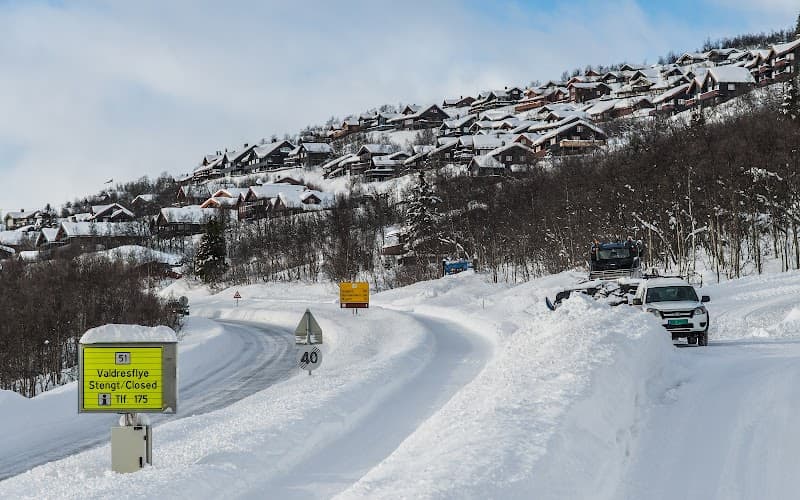
Most families will drive from Oslo. The route covers 220 km and takes three to three and a half hours on well-maintained Norwegian roads. Winter tyres are mandatory by law, and rental cars from Oslo Gardermoen airport (OSL) come equipped with them as standard, you won't need to request them or pay extra.
The drive passes through the Valdres valley, climbing gradually into the Jotunheimen foothills. It is scenic and straightforward, without the hairpin passes or chain requirements that can make Alpine transfers stressful with small children in the back seat. Fuel up before leaving Oslo since petrol stations thin out significantly once you pass Fagernes, roughly 50 km before Beitostolen.
Bus connections from Oslo exist as an alternative, though we don't have verified operator names or schedules. There is no direct train to Beitostølen.
For families flying from outside Scandinavia, Oslo Gardermoen is the arrival point. Budget carriers including Norwegian and SAS serve Gardermoen from most major European cities. From the airport, you're looking at three hours to resort, comparable to a Geneva-to-Verbier transfer, but on flat motorway rather than mountain switchbacks.
One practical note: Norway is not in the EU but is in the Schengen Area. UK and non-Schengen passport holders need valid passports for all family members, including infants. Check processing times early.
Common Questions
Everything families ask about this resort
Have a question we didn't cover? We'd love to add it to our guide.
The Bottom Line
Would we recommend Beitostølen?
What It Actually Costs
The extensive cross-country tracks are completely free and among the very best groomed in all of Norway, a significant added value for Nordic families.
A budget family of four skiing five days in a self-catering cabin: plan NOK 25,000-32,000 (~EUR 2,200-2,800). That is 15-20% below Hemsedal and Trysil for a quieter, more family-focused experience.
A comfortable family in a hotel with mountain dining: NOK 35,000-45,000 (~EUR 3,000-3,900). The biathlon and cross-country experiences add exceptional value that pure ski resorts cannot match.
Compare to Hemsedal (NOK 30,000-40,000/week, bigger terrain, more nightlife), Geilo (NOK 25,000-33,000/week, train access, similar size), or Trysil (NOK 28,000-38,000/week, more terrain, great family infrastructure). Beitostølen wins for families who want cross-country and biathlon alongside their alpine skiing.
Your smartest money move: Rent a cabin with kitchen, cook most meals, and spend the savings on a guided biathlon or cross-country experience. The free groomed cross-country tracks are among the best in the world, use them daily for zero additional cost.
The Honest Tradeoffs
The village is quiet and compact with limited dining and no meaningful nightlife.If you want a full week of lift-served skiing with progression from green to black runs, Trysil, Hemsedal, or Åre in Sweden are better choices with substantially more terrain variety and family infrastructure. Geilo offers more downhill terrain while maintaining a similar multi-activity approach.
Beitostølen is for families who see downhill as one activity among many and value the cross-country and wilderness access as equally important.
Would we recommend Beitostølen?
Book a cabin or hotel in Beitostolen village. If you want bigger downhill terrain, Hemsedal is 2 hours away. Trysil is Norway's largest and most family-focused. If cross-country is the priority, Beitostolen is hard to beat in Scandinavia. For a similar outdoor-culture experience, Geilo balances cross-country and downhill well.
Book a cabin through Beitostolen.com and buy multi-day passes for per-day savings. The February winterferie week is peak demand, early March offers longer daylight and better rates. The village has a Joker supermarket for basics. Oslo is 3.5 hours by car, and the drive through Valdres valley is scenic but slow.
Similar Resorts
Families who loved Beitostølen also enjoyed these
Myrkdalen
Hafjell
Hemsedal
Kläppen
Voss
Geilo
Transparency note: This content was created with AI assistance and reviewed by Tom Meredith, our editor. Prices, dates, and availability may change. We recommend confirming details directly with the resort before booking.