Kleinwalsertal, Austria: Family Ski Guide
Austrian village, German ski lifts, no border checks needed.
Last updated: August 2026
Austria
Kleinwalsertal
Book Kleinwalsertal if you're driving from southern Germany with kids who are learning, and you want a week where skiing is one of several things you do. The learning setup is the real draw, the combined pass buys you two countries for one price, and the villages run at a pace that suits families who are in bed by nine. Skip it if your family wants one enormous connected ski area (SkiWelt or Saalbach do that properly), if a bus transfer between mountains with a toddler sounds like the thing that'll break you, or if everyone in the group already skis well and wants vertical. Booking sequence: accommodation in Riezlern or Hirschegg first, because that's where the beginner infrastructure and the family hotels are. Then ski school, confirming the minimum age with that specific school if your child is 3 or 4. Then passes, which need no advance strategy since there's only one product. Drive in from Oberstdorf, roughly 2 to 2.5 hours from Munich, about 2 hours 20 minutes from Stuttgart, no Austrian vignette required.
Is Kleinwalsertal Good for Families?
Here's the thing about Kleinwalsertal: it's Austrian territory, and you can't drive there from Austria. No road connects it to the rest of the country. Every car, bus and delivery van comes in through Oberstdorf in the German Allgäu, which is exactly why families in Munich and Stuttgart treat this valley as their easy Austrian ski week.
The payoff for that geography is a lift pass that ignores the border. One Oberstdorf-Kleinwalsertal ticket covers 130 km of piste and 48 lifts on both the German and Austrian sides (lift operator figures, winter 25/26). Your kids get to say they skied two countries before lunch, and you only bought one ticket. Regional heritage sources trace the whole arrangement back to an 1891 customs treaty, which is also why the drive in needs no Austrian motorway vignette.
Best for families with beginners and young intermediates who want a short drive from southern Germany, quiet villages, and a week where skiing is one of several things you do rather than the only thing.
Real talk: the Kleinwalsertal side is three separate mountains connected by bus, not one big lift network. Confident skiers will have seen the valley by day three.
You have a confident intermediate or advanced skier in the family who needs real variety
Biggest tradeoff
What's the Skiing Like for Families?
Hold two numbers in your head. The Kleinwalsertal side is its own ski area of about 67 km spread over three mountains, running from 1,086 up to 2,030 metres (Vorarlberg Tourism figures for 25/26). The pass you bought also covers the Oberstdorf side across the border, which is where the total reaches 130 km and 48 lifts.
The three valley mountains
- Heuberg-Arena, roughly 20 to 22 km. The family sector, mostly blue runs, with a Skikindergarten, a Kinderteppich magic carpet for the smallest skiers and its own children's restaurant. This is where you start, and if your kids are brand new to skis it may be where you stay all week.
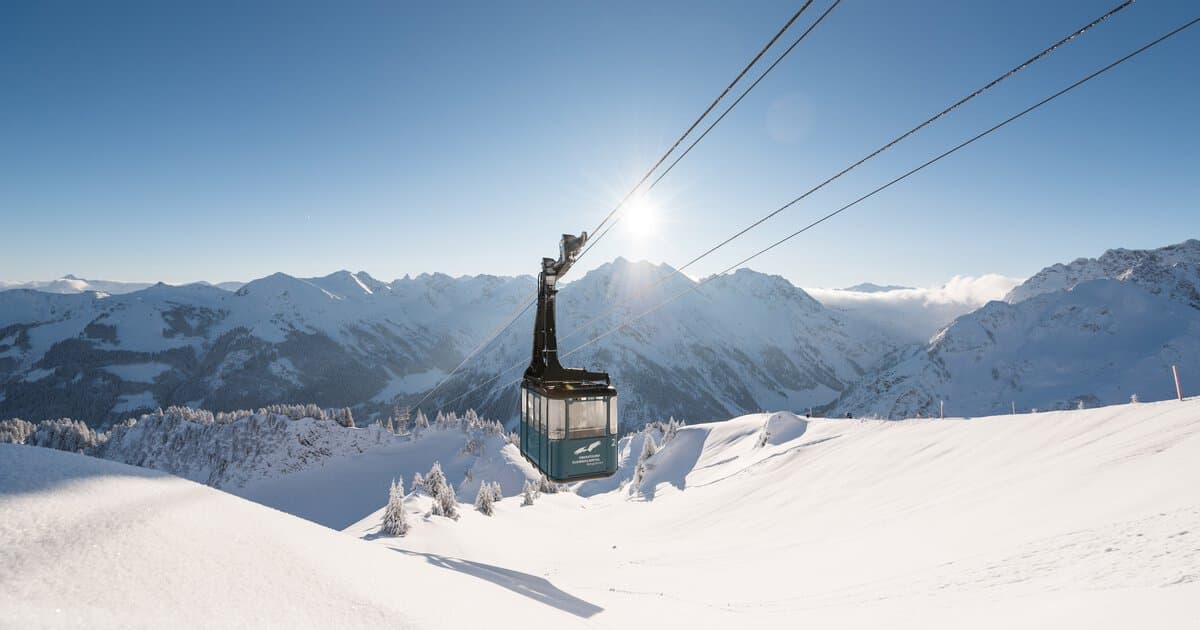
- Ifen, roughly 25 km plus a 1.2 km ski route, 1,270 to 2,030 m. The highest of the three, served by two 10-person gondolas (Ifen I and II) and a heated six-seat chairlift, the Olympiabahn. At the valley station there's Burmi's Winter Worlds, a marmot-mascot beginner zone with conveyor belts and a drag lift, plus the AlpinLodge Auenhütte for the hot-chocolate stop.
- Walmendingerhorn, roughly 15 km, topping out around 2,000 m. The lift operator's own description calls it the quietest of the three, which in practice means the shortest queues in the valley.
The catch, and it's the important one: these are three mountains, not three sectors of one lift network. You ride the bus between them.
Across the border
Fellhorn and Kanzelwand on the Oberstdorf side are what families graduate to. Relaxed blue runs (numbered 3 and 4) and easy family runs sit alongside proper reds for whoever in your group has stopped being impressed, and there's a Crystal Peak Park for the teenager who'd rather jump than carve, a panoramic mountain restaurant, and a children's playground at the Schlappoldsee. Same pass, no extra ticket, and it's the day your kids get to tell people they skied two countries.
Ski schools
The lift operator lists six ski schools on the Kleinwalsertal side: Skischule Hirschegg at the Heuberg-Arena valley station, Skischule Riezlern, Skischule Seite-Egg in Riezlern, Skischule Mittelberg, Skischule Bödmen-Baad and Die Skischule Ausser Hirschegg. A regional third-party source counts seven, so treat the exact figure as six or seven and choose by walking distance from your bed.
On minimum age, be careful what you copy from other guides. Skischule Hirschegg takes children from age 3 in its children's instruction, and that's the school the Alphotel uses for its own kids' programme. That's specific to Hirschegg, not a valley-wide policy you can assume, so if your child is 3 or 4, email the school you're actually booking before you commit to the week.
Nobody publishes a single valley-wide lesson price list, and rates move by school, week and package, so ask for your exact dates when you enquire. Book the school before the flights if your child's at the age where the week only works with lessons.
If you cross to the German side for lessons
Oberstdorf lists nine more ski schools. Neue Skischule Oberstdorf holds the "Kids on Snow" quality licence and runs the Sölli-Hasi-Kinderland with its own magic carpets, practice lifts, a warming room and toilets, which is precisely the detail that matters at 9am with a cold 4-year-old. Alpin Skischule Oberstdorf has its own Kinderland with a rope tow and two conveyor belts.
Trail Map
Full Coverage© OpenStreetMap contributors, ODbL
📊The Numbers
| Metric | Value |
|---|---|
Family Score | 6Average |
Best Age Range | 3–12 |
Kid-Friendly Terrain | 65%Very beginner-friendly |
Ski School Min Age | — |
Kids Ski Free | Under 6 † |
Score Breakdown
Value for Money
Convenience
Things to Do
Parent Experience
Childcare & Learning
How Much Are Lift Tickets?
This is the part that makes Kleinwalsertal unusual. There's no standard Kleinwalsertal-only day pass. Everything is sold as the combined Oberstdorf Kleinwalsertal ticket, valid on all 48 lifts across both countries, covering 130 km of piste.
Full-day combined pass (winter 25/26 operator rates)
- Adult: €68.70
- Teenager (born 2008 or 2009): €52.90
- Student or trainee: €52.90
- Child (born between 2010 and 2019): €29.00
- "Snowman" (born 2020 or later): €15.00
3-hour combined pass (winter 25/26)
- Adult: €54.30
- Teenager, student or trainee: €41.80
- Child: €25.00
- Snowman: €15.00
Söllereck only, the beginner mountain on the Oberstdorf side (winter 25/26)
- Full day: adult €56.90, teenager or student €48.00, child €29.00, Snowman €15.00
- 3 hours: adult €49.90, teenager or student €40.50, child €23.90, Snowman €15.00
Read that last one carefully before you buy it. Söllereck sits on the German side, and the ticket doesn't cover Heuberg-Arena, Ifen or Walmendingerhorn, so it only helps on a day you're skiing the German side anyway.
Two things worth knowing before you budget. First, kids don't ski free here. Plenty of guides say under-6s do. The operator's price list has no free band, and the youngest tier still pays €15.00. Second, the age brackets run by birth year, not age in years, which is a very German way to do it and means the bands roll forward every season. A child born in 2019 sits in the €29.00 band for 25/26, so re-check where they land next winter.
Those are 2025/26 rates, the last season the operator has published. 2026/27 pricing normally appears in autumn, so verify before you budget a trip for next winter.
One more thing, to set expectations: Kleinwalsertal isn't on Ikon, Epic or any of the big multi-resort passes, and it's in Vorarlberg rather than Tirol, so Tirol regional cards don't help either. The combined two-country ticket is the pass, and it's also the default, so there's nothing to optimise.
Planning Your Trip
🏠Where Should Your Family Stay?
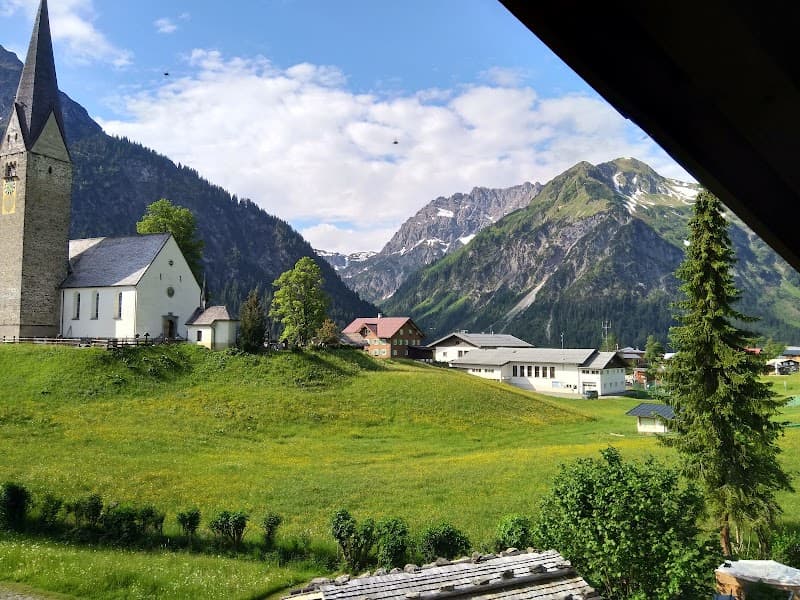
Four villages, strung along one road: Riezlern first as you come in from Germany, then Hirschegg, then Mittelberg, then tiny Baad at the end. Riezlern and Hirschegg put you closest to the beginner infrastructure. Baad is beautiful and it's the wrong call with a 4-year-old in ski boots.
Alphotel, Hirschegg
If I'm booking for my own crew with a small beginner in tow, this is where I start. On its own site the hotel describes itself as a Familotel-certified four star with ski-in, ski-out access into the Heuberg-Arena, an on-site "Alphotel Skiarena" with an 18-metre magic carpet for first-timers, a Happy Club Care childcare programme, a romper room and a children's restaurant. Lessons run through the neighbouring Skischule Hirschegg, which is based at the Heuberg-Arena valley station and takes children from age 3.
Those are the hotel's own claims about itself, so treat "certified" as their word rather than mine until you see it on your booking confirmation.
Der Kleinwalsertaler Rosenhof, Mittelberg
Der Kleinwalsertaler Rosenhof leans more resort-hotel than ski-lodge: its own kids' club ("Zwärg Bartli's Reich"), a heated infinity pool, an indoor pool with a children's splash area, a family sauna, and three-quarter board so nobody's hunting dinner at 6pm with tired children. Guests get the Allgäu-Walser-Card, which covers free regional bus travel.
The hotel markets itself on access to Söllereck, Ifen, Heuberg and Fellhorn-Kanzelwand. Read that as "the bus stops nearby and the guest card covers it", not as ski-in, ski-out to four mountains. Mittelberg sits partway up the valley, and the skiing starts where the lifts are.
✈️How Do You Get to Kleinwalsertal?
The valley sits in Austria's Vorarlberg, and there's no Austrian road into it. You arrive from Bavaria, through Oberstdorf, every single time. That sounds like a hassle and it's the opposite: it's Autobahn nearly the whole way, and the mountain road only starts in the last stretch.
Munich Airport (MUC) is the airport most international families use. Budget roughly 2 to 2.5 hours by car, depending on how the Allgäu interchange is behaving that morning. From Stuttgart, the drive is listed at about 2 hours 20 minutes via the A8, then the A7 towards Kempten, then the A980 towards Oberstdorf.
Memmingen (FMM) is the budget-carrier airport in the Allgäu, north of the valley. If Ryanair or Wizz Air fly there from your city, it's usually the cheapest door-to-slopes route you'll find. Innsbruck Airport (INN) looks close on a map, but the road has to loop the long way round the mountains, so check the actual routing before you assume it's quicker. Zurich Airport (ZRH) only makes sense on a much cheaper fare, since you're adding a third country's road rules to the trip.
By train
There's no station in the valley. Rail travellers ride to Oberstdorf Bahnhof (from Munich you change in the Allgäu, usually at Immenstadt) and then take the Walserbus for the final run into the valley. It works, and it's also exactly as fun as it sounds to wrestle ski bags and a booster seat onto a regional train. Drive if you've got the option.
Once you're here
Buses link Riezlern, Hirschegg, Mittelberg and Baad with the lift stations, and that matters more here than at most resorts, because the mountains don't link to each other on skis. Some accommodation issues the Allgäu-Walser-Card, which includes free regional bus travel: the Kleinwalsertaler Rosenhof gives it to guests, so ask whether yours does too before you factor in parking.
☕What's There to Do Off the Slopes?
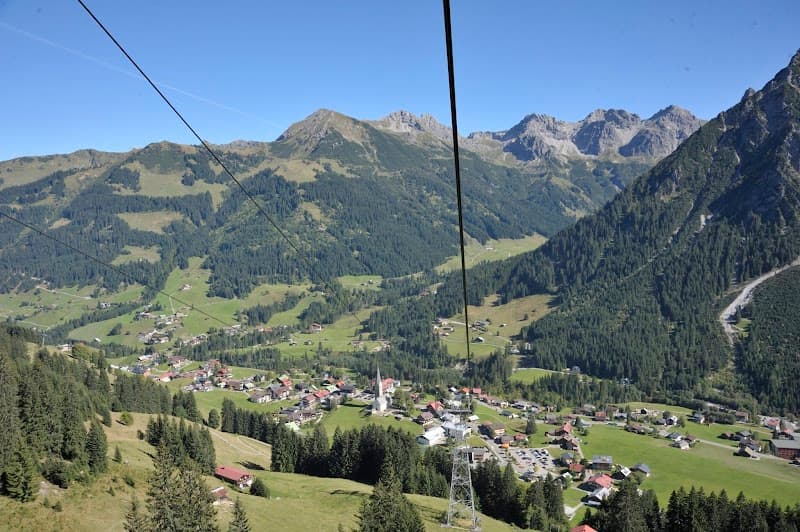
Kleinwalsertal won't win nightlife awards, and that's the point. The four villages, Riezlern, Hirschegg, Mittelberg and Baad, each have their own restaurants and their own personality, and the day tends to end with everyone properly tired rather than everyone wired.
Where to eat
Gasthof Hörnlepass in Riezlern is the version of dinner where you turn up in ski boots, nobody blinks, and the portions are sized for people who've been outside all day. It sits right on a cross-country trail.
Haller's Posthotel is the more polished regional cooking, without tipping into the kind of formal that makes a 6-year-old miserable. Good option for the one splurge night. A-ROSA Ifen is the closest thing the valley has to a cocktail bar.
Off the slopes
Tobogganing is the big one. The valley has natural Rodelbahnen through forest and open meadow, with sled hire from village sport shops, and the valley runs are usually calmer than the popular Söllereck run on the Oberstdorf side. Natural runs live and die by conditions, so ask locally on the day rather than promising the kids anything at breakfast.
Beyond that: groomed winter walking trails with hut stops, cross-country trails that run right past the village Gasthöfe, an ice rink in Riezlern, and cable cars that'll happily carry a non-skier up for the view and a long lunch. Programmes and opening days shift season to season, so confirm the current list with your accommodation when you check in.
Evenings
Evenings here are a glass of wine by a fire, not a DJ set. Hotel bars and Gasthöfe stay open into the late evening, with the occasional torchlit walk or fondue night. Most families are pleasantly finished by 9pm. That's not a bug.
When to Go
Season at a glance — color-coded by family score
💬What Do Other Parents Think?
Kleinwalsertal keeps a particular kind of family: young kids, a car, southern Germany or a cheap Memmingen flight, and no appetite for a resort that runs on lift-queue adrenaline. The infrastructure tells the same story the returning families do. A ski kindergarten, a magic carpet and a children's restaurant sit in the Heuberg-Arena. A mascot-themed beginner zone with conveyor belts sits at the foot of Ifen. The operator's own copy calls Walmendingerhorn the quietest of the three mountains. Nobody builds a valley like that for expert skiers.
Families on the Slopes
(8 photos)Photos from Google Places. Posted by visitors.
Common Questions
Everything families ask about this resort
Have a question we didn't cover? We'd love to add it to our guide.
The Bottom Line
Would we recommend Kleinwalsertal?
What It Actually Costs
What I can price exactly (lift operator rates, winter 25/26): two adults plus two children born between 2010 and 2019, all on full-day combined passes, is €195.40 for the day. A younger sibling born in 2020 or later adds €15.00. That's mid-tier for the Austrian Alps, and you're getting a two-country ski area for it.
Levers that actually move the number
- 3-hour tickets on learning days. Adult €54.30 instead of €68.70. For children the gap is small (€25.00 against €29.00), so the real play is a short ticket for the parent doing supervision duty and a full one for whoever's skiing until the lifts close.
- Discounted beginner passes at Ifen. The AlpinLodge Auenhütte at the Ifen valley station, right next to Burmi's Winter Worlds, offers discounted beginner passes. That's the in-valley way of not paying for 130 km your 4-year-old won't touch. Ask at the counter for the current rate, since it isn't on the operator's published price list.
- Don't reflexively buy the Söllereck ticket. It saves an adult €11.80 a day, but the child rate is €29.00 either way and the Snowman rate is €15.00 either way, and it doesn't cover Heuberg-Arena, Ifen or Walmendingerhorn. If your beginners are learning on the valley's own family mountain, it saves you almost nothing and sends you to the wrong hill.
- No Austrian vignette. The route in never joins the rest of Austria's motorway network, so that's one toll sticker you don't buy.
- A kitchen. Self-catered breakfast and a packed lunch, with one restaurant dinner, is the standard way families here cut the food line. Weigh it against half-board hotel rates rather than assuming it wins.
What you'll have to price yourself
Weekly lodging, lessons and food. Rates swing hard by village, by board level, and by whether your week collides with German school holidays, so a single weekly number would be fiction. Get real quotes for your dates, then compare.
One timing note: everything above is 2025/26 pricing, the last season the operator has published. 2026/27 rates usually land in autumn, and because the age bands run by birth year, they shift by one year with them.
The Honest Tradeoffs
The valley's three mountains don't connect on skis. Heuberg-Arena, Ifen and Walmendingerhorn are separate hills sharing one pass, and you move between them by bus. With small children in full kit that means unload, wait, load, and a morning you meant to start at first lift starts later than that. The guest card can make the bus free. It doesn't make it fast.
The 130 km headline includes another country. The Kleinwalsertal side is about 67 km. The rest of that number is Oberstdorf, on the German side, which means a bus or a drive out of the valley on the days you want it. Brilliant that the pass covers it. Not the same thing as skiing it from your hotel door.
Kids don't ski free. The youngest band still pays €15.00 a day (winter 25/26). Small money, but plenty of guides say otherwise, so budget from the operator's actual price list.
Terrain runs out. This is a beginner and easy-intermediate valley with a strong learning setup, and that's its whole identity. A confident 11-year-old will have ridden everything on the Kleinwalsertal side in two or three days, and you'll be crossing to Fellhorn and Kanzelwand for the rest of the week. If what you want is one enormous connected network to get lost in, Söll and the SkiWelt or Saalbach are fundamentally different holidays.
Would we recommend Kleinwalsertal?
Book Kleinwalsertal if you're driving from southern Germany with kids who are learning, and you want a week where skiing is one of several things you do. The learning setup is the real draw, the combined pass buys you two countries for one price, and the villages run at a pace that suits families who are in bed by nine.
Skip it if your family wants one enormous connected ski area (SkiWelt or Saalbach do that properly), if a bus transfer between mountains with a toddler sounds like the thing that'll break you, or if everyone in the group already skis well and wants vertical.
Booking sequence: accommodation in Riezlern or Hirschegg first, because that's where the beginner infrastructure and the family hotels are. Then ski school, confirming the minimum age with that specific school if your child is 3 or 4. Then passes, which need no advance strategy since there's only one product. Drive in from Oberstdorf, roughly 2 to 2.5 hours from Munich, about 2 hours 20 minutes from Stuttgart, no Austrian vignette required.
Similar Resorts
Families who loved Kleinwalsertal also enjoyed these
Radstadt-Altenmarkt
Sonnenkopf
Hochoetz-Kühtai
Itter
Gargellen
Schlick 2000
Transparency note: This content was created with AI assistance and reviewed by Tom Meredith, our editor. Prices, dates, and availability may change. We recommend confirming details directly with the resort before booking.