Ski Kindergarten and Ski School: What Age Can Kids Start in the Alps?
Most Alpine ski schools take kids from age 3 in a playful Kinderland, but real progress usually starts at 4 or 5. Here is what each age can actually join, what it costs, and how to tell if your child is ready.
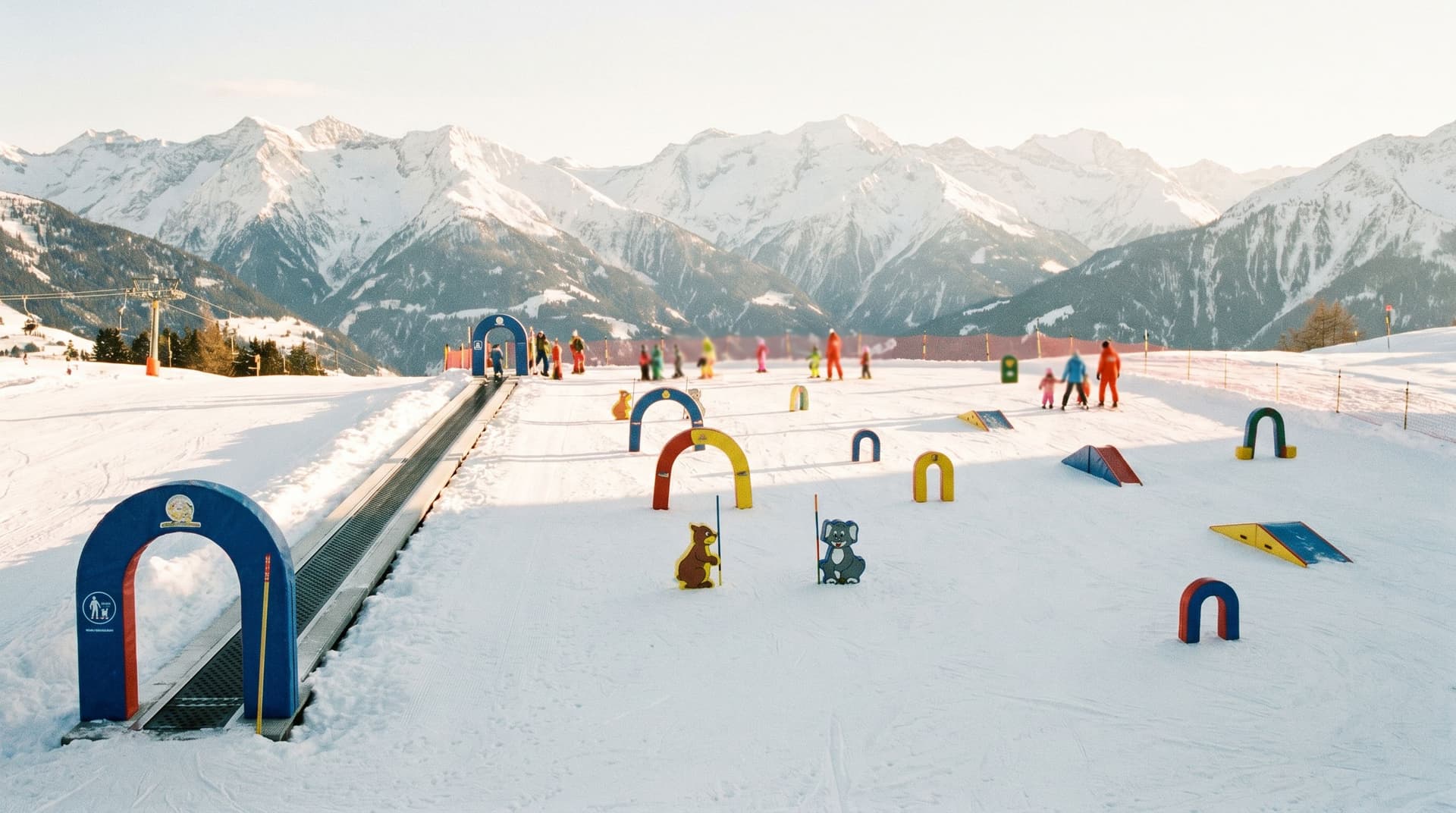
The honest answer to "what age can my kid start skiing in the Alps" is two answers. From age 3, almost every Austrian, Swiss and German ski school will take your child into a fenced Kinderland or snow garden, where the whole point is play and getting comfortable on snow. Real lessons that build actual skiing, the kind where a child links turns and rides a lift, usually click into place at 4 or 5.
Below 3, you are looking at childcare rather than skiing, and some resorts handle babies from a few months old. This guide separates the marketing from the reality: what a 2, 3, 4 and 5 year old can genuinely join, what the Austrian, Swiss and German systems call it, roughly what it costs, and the readiness signals that matter far more than the number on the birthday cake.
Ski Kindergarten vs Real Ski School: The Difference That Matters
These are two different products, and booking the wrong one wastes money. A ski kindergarten (Skikindergarten, Bambini, Kinderland, snow garden) is a playful introduction inside a flat, fenced beginner area. The goal is fun and confidence, not technique. A young child might spend a morning sliding two metres, falling over, and giggling. That is a success at this age.
Group ski school proper teaches skiing as a skill: snowplough, turning, stopping, riding a button lift or chairlift, then linking turns down a green run. Most children only get meaningful traction here from 4 or 5, once they can follow instructions in a group and have the stamina for it.
- Ski kindergarten or Kinderland: usually from age 3, play-led, flat fenced area, short sessions.
- Group ski school: meaningful progress from 4 to 5, technique-focused, lifts and real runs.
- The flat area itself: a Kinderland often has a magic carpet (Zauberteppich) conveyor belt and a gentle rope tow so tiny skiers never have to walk uphill.
- The trap: paying full-day group rates for a 3 year old who needs a play session, or booking a play group for a ready 6 year old who would learn faster in a real class.
What Each Age Can Actually Join
Use age as a rough filter, then check the readiness signals further down. Resorts and schools draw the lines slightly differently, so always confirm the exact minimum age and format on the specific ski school page before you book.
- Under 2: not skiing. This is pure childcare, available at some resorts from a few months old. Think creche, not slopes.
- Ages 2 to 3: childcare plus, at a handful of schools, a short daily snow taster in the snow garden, often with a parent present. Manage expectations: this is play.
- Age 3: the standard ski kindergarten entry. Half-day play sessions in the Kinderland. First slides, first magic carpet rides, plenty of breaks.
- Ages 4 to 5: the sweet spot for starting real group lessons. Attention span and balance are usually there, and progress over a week is visible and motivating.
- Age 6 and up: straight into standard group classes by level. A 6 year old who has never skied still starts as a beginner, just in a faster-moving group than a 4 year old.
Age Band, What They Can Join, and Typical Format
| Age | What they can join | Typical format and content | Honest note |
|---|---|---|---|
| 2 to 3 | Childcare and short snow taster (some schools, parent often present) | Snow garden play, very short sessions, lots of breaks | Toilet trained is the hard limit; many programmes refuse children still in nappies |
| 3 | Ski kindergarten or Kinderland | Half-day play sessions, magic carpet, no technique pressure | Expect play and confidence, not real skiing yet |
| 4 to 5 | Real group lessons, half or full day | Snowplough, turning, stopping, button lifts, first green runs | Best age to start if the child can follow group instructions |
| 6 to 7 | Standard group classes by level | Faster progress, longer days, parallel turns within a season or two | A non-skier still starts as a beginner, just learns quicker |
| 8 plus | Group classes, can handle full days | Most terrain within a few seasons, ready for varied slopes | Stamina and focus rarely the limiting factor here |
The Austrian, Swiss and German Ski School Landscape
The three big Alpine nations run similar ideas under different names. Knowing the labels helps you compare like for like and decode a booking page in a hurry.
- Austria (Skischulen): independent ski schools attached to most resorts, with Bambini or Skikindergarten programmes from age 3 and a dedicated Kinderland. Big family resorts run the largest, best-equipped children's areas.
- Switzerland (Schweizer Skischule): the red-jacket network uses the Swiss Snow Kids Village (with the mascot Snowli) for the youngest, then the Swiss Snow League, a four-tier ladder of Kids Village, Blue, Red and Black, with a medal at each level.
- Germany (DSV Skischulen): the German ski federation network runs Mini-Zwergerl courses for 3 year olds and Zwergerl for 4 to 5 year olds, often starting on home practice slopes before snow-safe Alpine courses.
- The shared concept: a snow garden or Kinderland with a magic carpet and rope tow, where play comes first and a child earns a small medal or sticker at the end of the week.
What to Expect: Half-Day, Full-Day, Lunch and Childcare
The single biggest decision for a 3 to 5 year old is half-day versus full-day. For most children at this age, mornings are gold and afternoons are a meltdown, so half-day group lessons (typically two hours, often 10am to 12pm) are the sensible default. Full days only make sense once a child has the stamina, usually from age 4 or 5 and up.
- Group size: smaller is better for little ones. Ask the number before you book, and favour schools that cap young groups tightly.
- Lunch and childcare combo: many schools offer midday supervision with lunch as a paid add-on, which bridges a morning lesson and an afternoon nap or play. Useful when both parents want to ski.
- Non-skiing toddlers: larger family resorts run a separate creche or Kids Club, sometimes from age 2 or even younger, so the older sibling can learn while the baby is cared for.
- Equipment: children's course prices sometimes include ski rental, sometimes not. Confirm this, because it changes the real cost noticeably.
Realistic Prices for Kids Courses and Childcare
Prices vary a lot by resort, season and school, so treat these as honest ballparks and confirm the current figure on the official ski school page. As a guide, a half-day children's group course often runs in the region of 80 to 100 EUR per day in Austria, with a five or six day week landing around 330 to 360 EUR, sometimes with ski rental included.
- Austrian Bambini, half day: roughly 89 EUR for one day, around 329 to 349 EUR for a five to six day week at busy family schools, equipment sometimes included.
- Austrian full day (age 4 plus): roughly 119 EUR per day, around 339 to 359 EUR for the week.
- Swiss snow garden and Kids Village: half-day rates in the order of 45 to 60 CHF per day, around 225 to 245 CHF for five half-days at a resort like Davos. Always check the exact figure locally.
- Midday lunch and supervision: often an add-on of around 20 EUR per child per day.
- Non-skiing childcare: pricing varies widely and some resorts include limited hours for guests, so verify it on the official resort site rather than assuming.
Is My Child Ready? Signals That Beat Age
Age is a blunt tool. A focused 3 year old can have a brilliant week while a tired, overwhelmed 5 year old cries on the carpet. Before you book, run through these readiness signals, because they predict a good week far better than the birthday.
- Out of nappies: this is the hard one. Most ski kindergartens require children to be toilet trained, because instructors cannot change a whole group. If your child is still in nappies, it is too early for a course, full stop.
- Follows simple instructions: can they listen to an adult who is not you, in a group, and do what is asked? Kindergarten experience helps enormously here.
- Attention span: small children fade fast. If two hours of focused activity is a stretch at home, a full day on snow will not work. Start with half days.
- Comfortable away from you: a child who separates happily at nursery will settle on the slope. A clingy day-one is normal, but persistent distress is a sign to wait or go private.
- Physically up for it: by 3 to 4 most children have the balance and leg strength for gentle sliding. Pushing earlier rarely speeds anything up.
Frequently Asked Questions
What is the youngest age a child can start ski school in the Alps?
Is there childcare for non-skiing toddlers at ski resorts?
What is the difference between ski kindergarten and ski school?
Private or group lessons for a young child?
Half-day or full-day lessons for a 4 year old?
What does a magic carpet or Zauberteppich do?
How do I know if my child is ready, regardless of age?
Resorts families ask about
Kindergarten and garderie in Pralognan-la-Vanoise
The top GSC query in this cluster (199 impressions). Village children's club plus ESF Piou-Piou — use the parent words, not just "childcare."
Kindergarten La Rosière — family setup
Parents search “kindergarten rosiere” (98 impressions). The resort page should be the answer, not only this explainer.
Kindergarten Bonneval-sur-Arc
“kindergarten bonneval sur arc” is already impressing with no clicks. Send that intent here.
Kindergarten Montgenèvre: ESF garderie from 6 months
Parents search “kindergarten montgenevre.” Visitor care is ESF. The municipal creche is residents-only.
Kindergarten Les Orres: Club des Marmottes at 1800 only
Club des Marmottes is at 1800, not 1650. Ages 6 months to 5. Do not write it as resort-wide.
Kindergarten at Sommand, not Praz de Lys village
GSC query “kindergarten praz de lys” (154 impressions). No garderie in the village. Halte-Garderie de Sommand takes walking children 1-6.
Get our free family ski trip checklist and one useful email a month.
Ready to Plan Your Trip?
Use our tools to find the perfect family ski resort.
More How-To Guides
40 Alps Experiences Worth Crossing the Ocean For. The Best One Costs Nothing
Forty sourced Alps experiences for families: car-free villages, birth-year lift rules, ski kindergarten, glacier days, and the free evening walk most itineraries treat as a corridor.
How-To GuidesMilan to Cortina With Kids: Complete Transportation Guide
Every option for getting from Milan to Cortina with children. Trains, buses, rental cars, and private transfers compared.
How-To GuidesThe Ultimate Family Ski Trip Checklist
Everything you need to pack for a stress-free family ski vacation, organized by timeline and age group.
Transparency note: This content was created with AI assistance and reviewed by Tom Meredith, our editor. Prices, dates, and availability may change. We recommend confirming details directly with the resort before booking.