Family Ski Budget: What a Week in the Alps Really Costs
A line-by-line week-in-the-Alps budget for a family of four, with realistic ranges for Austria versus Switzerland, the cheap French Alps resorts that undercut both, and the savings levers that actually move the total.
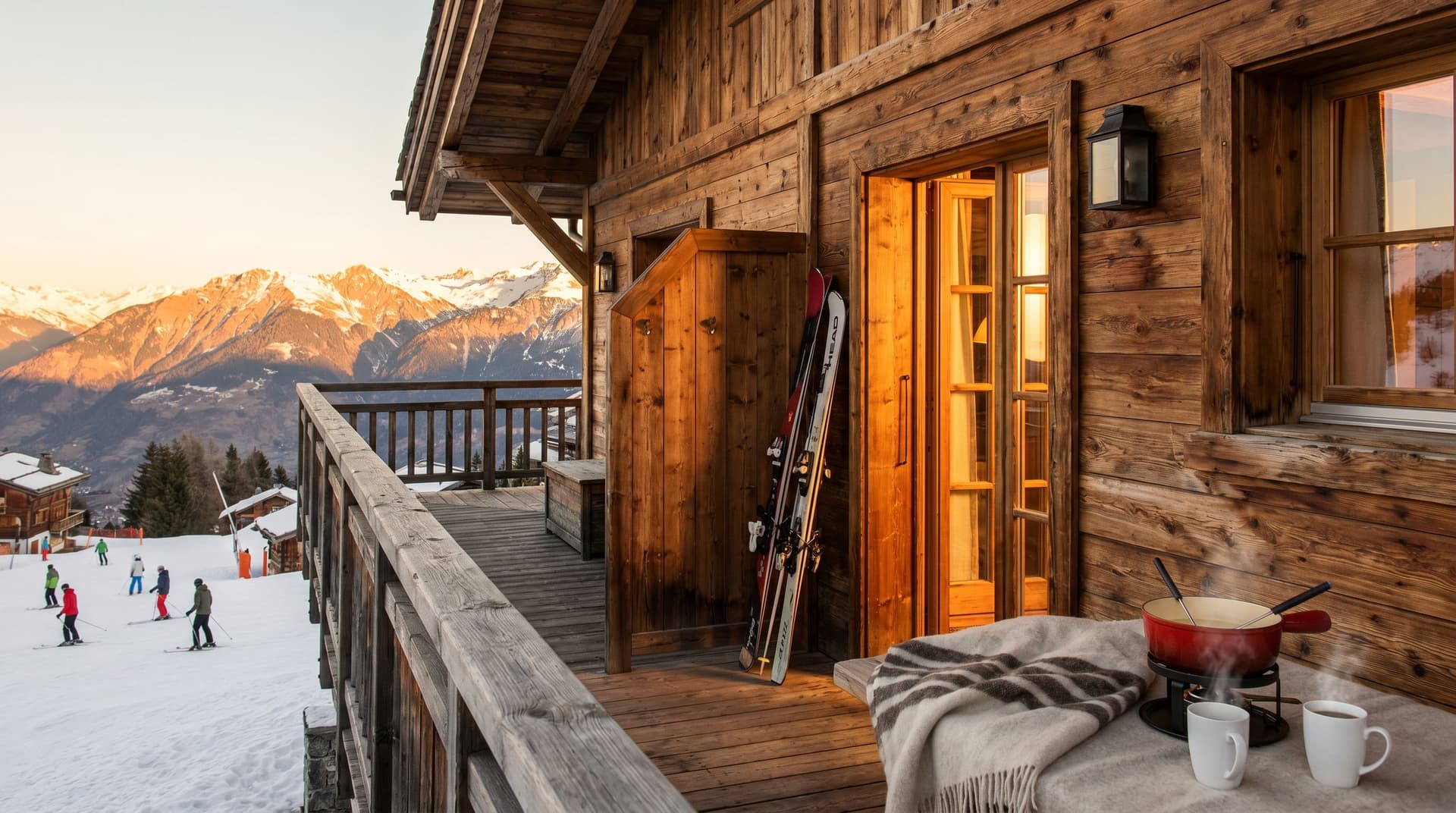
A ski week for a family of four does not have one price; it has a budget you build line by line. The big levers are accommodation, lift passes, kids' ski school, rental gear, food, and travel, and each one swings by hundreds of euros depending on the choices you make. Get those choices right and a week in Austria or a small French resort can land near the cost of a normal summer holiday. Get them wrong and the same week doubles.
Here is the honest breakdown: realistic ranges for each line, where Austria and Switzerland diverge (Switzerland runs roughly 20 to 30 percent more), where the small French Alps resorts undercut both, and the specific moves that cut the total without cutting the trip. The numbers below are ranges to plan against, not quotes, and every French figure carries the season it was published for. Confirm every figure on the resort's and operator's own site before you book.
The six budget lines that decide your total
Almost the entire cost of a ski week sits in six lines. Two of them, accommodation and lift passes, usually make up more than half the total, so that is where the planning effort pays off. The rest add up faster than families expect.
- Accommodation: the biggest single line, and the one with the widest spread. A self-catering apartment (Ferienwohnung) is typically the cheapest route; a hotel with half-board (Halbpension) is more comfortable and far pricier.
- Lift passes: the second heavyweight. A family of four pays adult rates twice and child or junior rates twice, and kids' discounts plus under-age free-skiing cutoffs change the total a lot.
- Kids' ski school: usually non-negotiable on a first or second trip, and a serious line for two children across five mornings.
- Ski and boot rental: per person, per day, for anyone who does not own gear. It is cheaper than buying for a once-a-year family, but it is not small.
- Food: the line you control most. Self-catering dinners versus restaurant dinners, and packed lunches versus mountain-hut lunches, can swing the week by hundreds.
- Travel and incidentals: car plus fuel plus tolls versus train, plus the small costs (vignette, parking, deposits, a forgotten glove) that quietly add up.
Accommodation: apartment versus hotel half-board
This is the choice that sets the ceiling on your whole budget. The real decision is self-catering flexibility versus hotel convenience, and the price gap between them is large.
- Ferienwohnung (self-catering): usually the cheapest option, and it unlocks the single biggest food saving because you cook your own dinners. Good for budget-focused and larger families. The trade-off is that you shop, cook, and clean up on holiday.
- Hotel with half-board: breakfast and dinner included, no cooking, often a pool and kids' facilities. As a rough Austrian planning range, a one-week stay for four in a mid-range three-star hotel commonly lands somewhere around 1.300 to 1.600 EUR, climbing in the peak February holiday weeks. Switzerland runs markedly higher for the equivalent.
- Location premium: ski-in, ski-out and village-centre beds cost more. A place a short bus ride or drive from the lift is often dramatically cheaper for the same week.
- Check what is included: tourist tax (Kurtaxe), final cleaning, parking, and a guest card that bundles free buses or pool entry all change the true price. Read the listing before you compare.
Lift passes: where the kids' discounts live
Lift passes are the second-largest line, and the one where family discounts actually change the maths. Buy the six-day pass for everyone and check the child policies before you assume a price.
- The adult anchor: a six-day adult pass in a large Austrian area commonly sits in the region of 350 to 400 EUR per adult. Switzerland runs higher, often well above that per adult once converted from francs.
- Child and junior rates: children pay far less than adults, and teens fall into a discounted junior band. The exact ages and prices vary by area, so confirm them.
- Free skiing for the youngest: the youngest children often ski free below a cutoff, and several large Austrian areas run family bonuses (for example, a third child skiing free, or kids free in the late-season weeks). These offers move year to year; verify on the area's pricing page.
- Buy online and early: booking on the resort's official site before the season can shave a meaningful slice off the counter price, and it skips the queue on arrival.
Ski school, rental, and the food trap
These three lines are where careful families either save real money or quietly bleed it. Ski school is largely fixed; rental and food are where your choices matter most.
- Kids' ski school: a five-day group course per child commonly lands in the rough range of 300 to 400 EUR, sometimes more for full days with lunch included. For two children that is a substantial line, but it is what makes the holiday work, because the kids learn safely while parents ski.
- Ski and boot rental: in Austria, plan roughly 25 to 40 EUR per adult per day and less per child; many shops price a weekly package below the daily rate. Switzerland can run close to double. Booking rental online in advance often beats the walk-in price.
- The euro am Berg trap: lunch on the mountain is the silent budget killer. A hut lunch for four, with drinks, can run 60 to 100 EUR a day, which is several hundred euros across a week. A packed lunch (rolls, fruit, a thermos) or a quick stop back at a slope-side apartment cuts that line to almost nothing.
Travel: car versus train from Germany
How you get there is a real line, not a rounding error, especially from Munich, Stuttgart, Frankfurt, or Cologne. The car-versus-train choice changes both cost and stress.
- Car (the usual default): fuel plus tolls plus the door-to-door flexibility families love. Budget the Austrian vignette at 12,80 EUR for the 10-day sticker (2026 rate, and it is usually indexed each year, so recheck before you travel), or the Swiss annual vignette at CHF 40 (Switzerland sells no short-term car vignette). Winter tyres are mandatory in Austria from 1 November to 15 April, so check a hire car before you cross the border.
- The Saturday-traffic tax: Saturday changeover days on the A8, A93, A12, and the Fernpass are notorious. Travel midweek or very early, or you pay in hours.
- Train and night train: the OEBB Nightjet runs into Tyrol (Munich onward via Kufstein, Woergl, Jenbach, Innsbruck), with under-fives travelling free on a shared berth and discounts for ages 6 to 14. Combined train-plus-lift-pass packages exist for several Tyrolean areas. It removes the drive and the parking, but you trade door-to-door flexibility for the resort's local buses.
Budget versus comfort: a week for four
| Cost line | Budget scenario | Comfort scenario | Biggest lever |
|---|---|---|---|
| Accommodation (1 week, 4 people) | Self-catering apartment, short ride to the lift | Three-star hotel with half-board in the village | Apartment versus hotel; distance from the lift |
| Lift passes (6 days) | Mid-size area, kids' and junior rates, booked online early | Marquee area at full counter price | Choose the area; book early; claim child free-skiing |
| Kids' ski school (2 children, 5 days) | Half-day group course | Full-day course with supervised lunch | Half-day versus full-day |
| Ski and boot rental | Weekly online package, basic gear | Premium gear, walk-in shop | Book online; weekly package over daily |
| Food | Self-catering dinners, packed lunches | Half-board dinners, daily hut lunches | Cook dinners; pack lunches off the mountain |
| Travel (from Germany) | Car midweek, 10-day vignette, packed snacks | Flexible dates, hut stops en route, peak Saturday | Off-peak timing; car versus train |
Austria versus Switzerland versus France
Country choice is the single biggest swing on the whole budget. For a German family of four, the broad pattern is consistent year to year, even as exact prices move.
- Austria, the value default: the best all-round price for big linked areas, strong family infrastructure, and short drives from southern Germany. This is where most budget-conscious DACH families land, and where the numbers above are anchored.
- Switzerland, the premium: expect roughly 20 to 30 percent more across lift passes, rental, and accommodation once you convert from francs. Stunning, well run, and worth it for some, but it is the expensive end. Always price it in euro equivalent before you commit.
- France, the lane families skip: the famous French resorts are expensive, which is why a lot of families write off the whole country. The small ones are not expensive at all. Six-day passes in the French value tier start well below the Austrian anchor above, and ESF children's courses undercut Austrian group courses on price. The three sections below have the numbers, resort by resort.
- Cheaper alternatives: smaller Austrian, French and Italian areas, and resorts a short transfer from the lift rather than ski-in, ski-out, can undercut the marquee names hard for a similar week. Late-season weeks (mid-March on) often pair the best prices with the longest days and the most kids-ski-free deals.
The French Alps on a budget
France is missing from most family ski budget conversations, and that is a mistake built on the famous names. Val d'Isère, Courchevel and Tignes really are expensive: one French budget calculator puts a family week in Val d'Isère at around 2.866 EUR against a national average of about 1.450 EUR. So France gets written off. But the small French areas sit in a completely different bracket, and several of them undercut the Austrian six-day passes quoted above.
Real talk: read the season label before you read the price. French resorts publish next winter's lift-pass grid late, usually in September or October. As of August 2026, most of the small areas below still show their 2025-26 grid, for a season that ended in April 2026. Every figure here is tagged with the season it belongs to. Where it says 2025-26, use it as a planning anchor and expect the 2026-27 grid to land a little higher, typically 2 to 5 percent. Only Les Orres had a confirmed 2026-27 pass grid live when we checked.
- Montgenèvre, Hautes-Alpes: a French price aggregator lists the six-day adult pass at 278,50 EUR and the six-day child pass (ages 6 to 14) at 223 EUR for 2025-26. We could not confirm those on the resort's own booking site, so treat them as a ballpark rather than a quote. Montgenèvre also runs a Family Pass for two adults plus two to five children, but you have to buy it at least 12 days before you arrive, and the family rate itself is not published anywhere we could verify. Worth a call before you build it into the budget. The upside here is the mountain: a piste links Montgenèvre straight into Italy's Via Lattea circuit.
- La Rosière, Savoie: 295 EUR for a six-day adult pass and 221,50 EUR for a child aged 5 to 12 in 2025-26 (that season ran 13 December 2025 to 18 April 2026), and it buys the whole Espace San Bernardo, so a confident family can ski over into Italy for lunch. Buy four or more six-day passes together and an 8 percent group and family discount applies, bringing it to roughly 271,50 EUR per adult and 204 EUR per child. Under-fives ski free. Careful here: some listings quote those discounted figures as the standard rate, which they are not.
- Pralognan-la-Vanoise, Savoie: every price source we found puts Pralognan well below the others, and we are still not going to quote you a number. Three separate listings gave three different 2025-26 six-day figures, almost certainly mixing low-season and standard-season windows, so check the official domaine skiable grid for your exact dates instead of trusting an aggregator. Local write-ups describe a family pack worth about 10 percent for two adults plus two children, and a 20 percent discount for under-12s on any pass type. Treat that as a lead to confirm, not a promise.
- Valmorel (Le Grand Domaine), Savoie: 294 EUR adult and 241 EUR child (ages 5 to 17) for six days in 2025-26 (20 December 2025 to 10 April 2026), taken from the resort's own booking site. The Pass Tribu-Famille takes 10 percent off when you buy three or more passes of six days or more in one transaction, which for a family of four is automatic.
- Les Orres, Hautes-Alpes: the one resort here with confirmed 2026-27 pricing already live, and the cheapest headline numbers of the group. High season (19 December 2026 to 19 March 2027) is 239 EUR adult and 199 EUR child aged 5 to 11, or 227 EUR and 189 EUR with the online promotion. Mid-season drops to 203 EUR and 169 EUR, low season to 179,50 EUR and 149,50 EUR. The Tribu family package, for four or more people paid in one go, is 220 EUR per adult and 183 EUR per child for six days, and the six-day child pass includes a free sledding token.
Line those up against the Austrian anchor earlier in this guide and the shape of the argument is obvious. A family of four on low-season Les Orres passes pays 658 EUR for the week, which is less than two adults alone at the 350 to 400 EUR Austrian rate. That gap is the entire case for the small French resorts.
ESF week prices: what French ski school actually costs
Ski school in France means ESF, the École du Ski Français, in almost every village, and its pricing is refreshingly plain compared with the lift-pass grids. Better still, the ESF booking systems are ahead of the lift companies: several already had confirmed 2026-27 prices live when we checked in August 2026.
- La Rosière: a six-day children's group course, one session a day, starts at 230 EUR for 2026-27, with bookings already open. The two sessions a day version starts at 414 EUR. Levels run from Flocon up to 3ème Étoile. The lift pass and insurance are not included.
- Pralognan-la-Vanoise: a five or six lesson group course for children aged 5 to 12 runs 149 to 163 EUR for winter 2026-27, depending on whether you book the Ourson à Étoile d'Or track or the Ourson à Team Étoiles one. The medal is included. The lift pass is mandatory from the first lesson and is not included.
- Valmorel: a six-day children's group course for ages 6 to 12 is listed from 203 EUR, but the page does not state which season it applies to, so confirm the year when you book.
- Montgenèvre: the local ESF publishes its course structure (Cours Collectif 10, Cours Super 6) but no prices we could verify online. Phone the school for a quote rather than assuming it matches its neighbours.
Set that against the 300 to 400 EUR per child that a five-day Austrian group course commonly costs and the gap is real: two children through a week of ESF mornings at Pralognan can come in under what one child costs in a big Austrian resort. Two honest caveats, though. French group courses are often shorter than the Austrian full-day equivalent, and the lift pass is never bundled in, so compare hours and inclusions rather than headline prices.
The apartment reality: what a French self-catering week costs
Budget skiing in France runs on self-catering apartments, mostly in residences operated at scale by Pierre & Vacances, Odalys, MMV and their competitors. That format is what the whole French price structure assumes, and it is a large part of why the country can be cheap.
Getting a real quote is the hard part. Operator sites price dynamically by date and block automated checks, and none of the five resorts above publishes a standing weekly rate. As a planning band across the northern French Alps, a four-person apartment for a week runs roughly 500 to 700 EUR in January and other low-season weeks, and 850 to 1.200 EUR in the February school-holiday weeks. Treat that as directional only. Those are 2026-dated regional benchmarks, not a published season grid and not a quote for any of these five resorts, and February is the most contested week of the French season.
Three things the headline rate almost never includes:
- Taxe de séjour: the local tourist tax, charged per person per night on top of the rate, exactly like the Austrian Kurtaxe.
- Final cleaning and the linen pack: usually optional line items you either pay for or handle yourself. Bringing your own towels and sheets is a real saving on a family unit.
- What "four person" means: French residences count sleeping places, not bedrooms. A unit sold for four is often a studio with a fold-out bed in the living area. If you want a separate room for the kids, price the next size up and compare the two properly.
Then the running costs, again on 2026-dated benchmarks rather than a resort's own tariff. Plan 12 to 20 EUR per adult per day if you are self-catering, and remember that resort supermarkets run around 20 percent above valley prices, so the big shop in the last town before the climb is worth the stop. Gear rental for six days is commonly quoted around 95 to 110 EUR per adult and 45 to 55 EUR per child, which lands at or below the Austrian 25 to 40 EUR per adult per day once you multiply it out, although Austrian weekly packages narrow that gap.
Add it all up and the same French calculator puts the national average for a family of four at about 1.450 EUR a week, with the Alpes du Sud value resorts (the class Les Orres and Montgenèvre belong to) landing around 1.200 to 1.500 EUR. Its split is roughly 45 percent accommodation, 25 to 30 percent lift passes, 10 to 15 percent food, 10 percent rental and 5 to 10 percent transport. That is one aggregator's model rather than a survey, so use the shape of it more than the exact total: accommodation and lift passes are still more than two thirds of your week, exactly as they are in Austria.
Which of the five we cover in depth suits you comes down to what you are optimising for. Les Orres is the only one with a confirmed 2026-27 pass grid and the cheapest headline numbers of the group, so it is the easiest week to budget accurately right now. Pralognan-la-Vanoise is the cheapest ski school and the lowest pass prices on every listing we found, so it is the one to check the official grid for. Valmorel publishes its pass prices on its own booking site and takes 10 percent off with the Pass Tribu-Famille, so what you see is what you pay. La Rosière costs more but buys a two-country ski area and lets under-fives on free. Montgenèvre sits mid-pack on price, with the Via Lattea circuit one piste away in Italy.
The biggest savings levers, ranked
Not all savings are equal. A handful of moves shift the total by hundreds; the rest are rounding. Pull the top levers first.
- 1. Pick the country and area: choosing Austria over Switzerland, and a mid-size area over a marquee name, is the largest single saving available. It dwarfs every coupon.
- 2. Go off-peak: the February holiday weeks are the most expensive of the season. If your Bundesland's break allows it, a week in January or from mid-March can cut accommodation and pass prices sharply.
- 3. Self-cater your dinners and pack your lunches: the food line is the one you control most. Cooking dinners and avoiding daily hut lunches can save several hundred euros over the week.
- 4. Book early: early-bird accommodation and online lift passes (German families typically book 12 to 26 weeks out) routinely beat late and counter prices.
- 5. Compare package versus DIY: a tour-operator package (travel, lodging, sometimes the pass) sometimes beats booking each line yourself, and sometimes does not. Price both ways before you decide; do not assume either is cheaper.
Timing it to the school holidays
Off-peak is the lever most families cannot fully use, because the school calendar pins them to the priciest weeks. Knowing your own Bundesland's dates is the first step to dodging the peak.
- The peak weeks: the late-February breaks are the most expensive of the season. In 2026, Bayern and Thueringen run 16 to 20 February, Sachsen 9 to 20 February, and Berlin and Brandenburg 2 to 7 February.
- The staggered advantage: not every state has a dedicated winter week. Baden-Wuerttemberg, Hessen, and Nordrhein-Westfalen have no fixed winter break, and Hamburg's spring break falls later (around early March), which can open cheaper, quieter weeks.
- Use the gaps: if your state's break is flexible or absent, target January or mid-March. If it is fixed in peak February, booking very early is your main defence on price.
- Always reconfirm dates: holiday dates and resort prices both shift; check your state's official calendar and the resort site before you lock anything in.
Frequently Asked Questions
What does a week of skiing in the Alps cost for a family of four?
Is Switzerland really more expensive than Austria for families?
What is the single biggest way to save money on a ski week?
How do I avoid overspending on food on the mountain?
Is the car or the train cheaper for getting there?
Is France cheaper than Austria for a family ski week?
Which French Alps resorts are cheapest for families?
How much does ESF ski school cost for a week?
Get our free family ski trip checklist and one useful email a month.
Ready to Plan Your Trip?
Use our tools to find the perfect family ski resort.
More How-To Guides
Milan to Cortina With Kids: Complete Transportation Guide
Every option for getting from Milan to Cortina with children. Trains, buses, rental cars, and private transfers compared.
How-To GuidesThe Ultimate Family Ski Trip Checklist
Everything you need to pack for a stress-free family ski vacation, organized by timeline and age group.
How-To GuidesWhen to Book Your 2026-27 Family Ski Trip
A month-by-month booking timeline for the 2026-27 season, with the real pass deadlines, the 2027 school holiday collisions (English half-term splits across two weeks), and honest flags on what is reported versus confirmed.
Transparency note: This content was created with AI assistance and reviewed by Tom Meredith, our editor. Prices, dates, and availability may change. We recommend confirming details directly with the resort before booking.