Driving to the Alps: Tolls, Vignettes and Winter-Tyre Rules, Country by Country
Five countries, five different systems, and one widely repeated French fine that, on the government's own February 2026 answer, was not yet enforceable. What to buy, what to fit and what you can stop worrying about, with the season and the source behind every number.
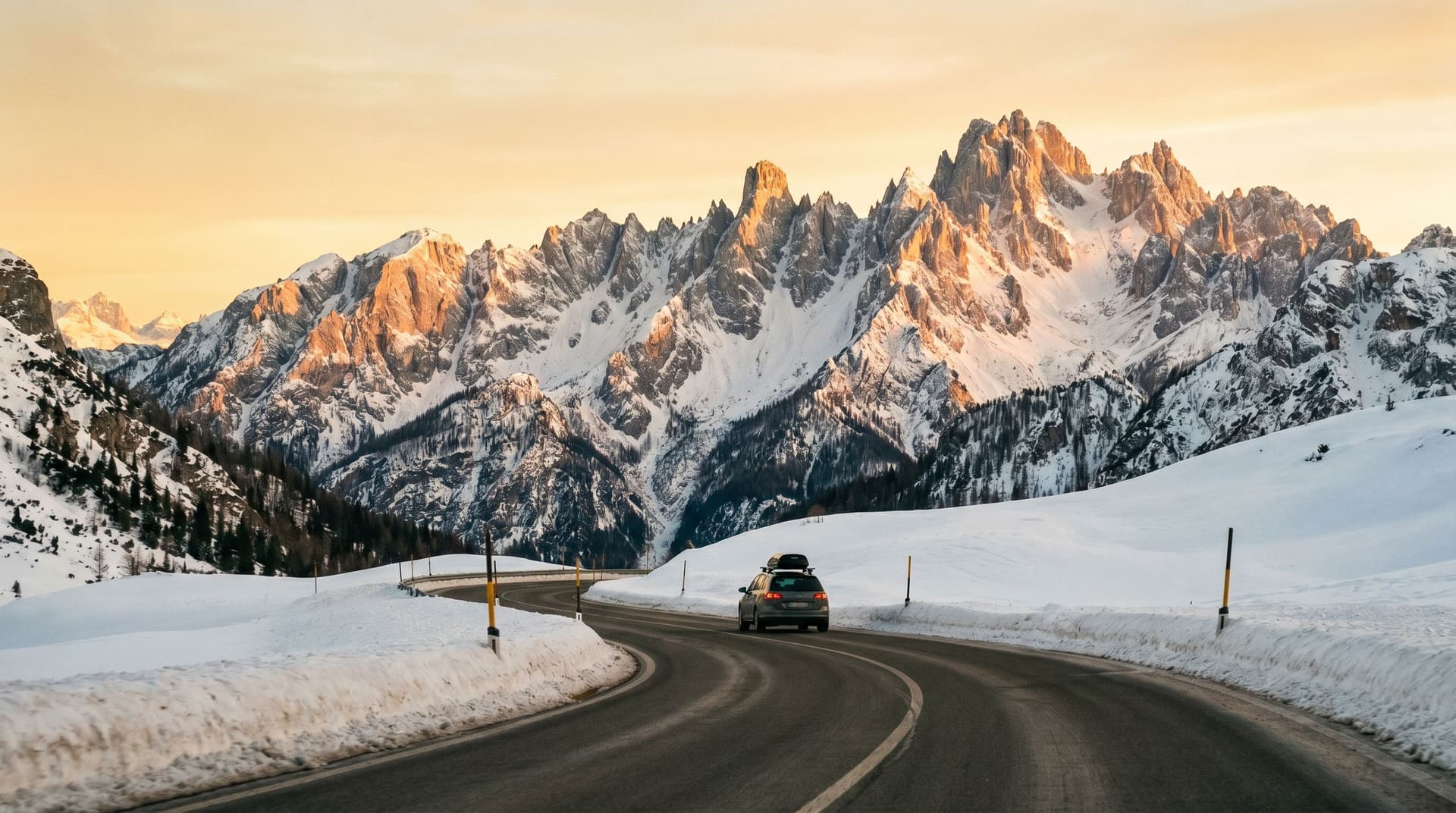
You are loading the car for the Alps and the same small worry keeps surfacing. Is there a sticker you were supposed to buy. Is there a tyre you were supposed to fit. Is there a fine waiting at a border you did not realise was a border.
Here is the honest shape of it. None of this is hard, none of it is expensive, and almost all of it is solved in the twenty minutes before you leave the driveway. What it does require is knowing that the five countries you might drive through handle it five completely different ways, and that the single fact almost every travel site states most confidently about France was not true as of the government's own answer of 12 February 2026.
This page is information, not legal advice. Every figure below carries the season or the vignette year it applies to, because these numbers change annually. Where we are relying on a motoring club or a press report rather than the statute itself, we say so in the same sentence.
The short answer
Austria: buy a vignette before you touch the motorway. For the 2026 vignette year that is 106.80 euro for the annual, 12.80 euro for ten days. Then budget separately for five toll roads the vignette does not cover, including the whole Brenner.
Switzerland: one sticker, CHF 40, unchanged for decades. If you are towing anything, the trailer needs its own second CHF 40 vignette. No winter-tyre law at all.
Germany: nothing to buy for a car. Winter tyres are required only when the road is actually icy or snow-covered, with no calendar dates. You may need a green sticker for a city centre.
France: no vignette. A real winter-equipment obligation applies in listed mountain communes from 1 November to 31 March, and the 135 euro fine everyone quotes for breaking it was not yet enforceable as of the government's answer of 12 February 2026. Comply anyway, for reasons that have nothing to do with fines.
Italy: no vignette either, but the Austrian A13 Brenner toll on the way in surprises many drivers, and the vignette does not cover it. Italy's on-mountain rules changed in 2025 and most of the internet has not noticed.
France: the fine everyone quotes, and why it was not a fine as of February 2026
This is the part of the drive that generates the most anxiety and the most wrong information, so it is worth getting exactly right.
What the obligation actually is. Article D.314-8 of the Code de la route, inserted by decret n. 2020-1264 of 16 October 2020, has been in force since 1 November 2021. It does not apply across France, and it does not automatically apply across a whole department. Within the mountain massifs defined by the law of 9 January 1985, the prefect of each department decides, by order issued after the opinion of the massif committee, the list of communes where the obligation bites. Some prefectures go all in: the Savoie prefecture states that the entire territory of Savoie is covered by the full winter-equipment obligation, from 1 November to 31 March. Others publish a commune list, and the list can be amended mid-season.
When. The decree defines the winter period in its own text: it begins on 1 November and ends on 31 March of the following year. For the 2025/26 season that was 1 November 2025 to 31 March 2026.
What satisfies it for an ordinary family car (vehicle category M1 or N1) is one of two things. Either you carry removable anti-skid devices capable of equipping at least two drive wheels, or you fit winter tyres on at least two wheels of each axle. You do not need both. Worth a precision here, because it changes what you buy: the decree's own words are dispositifs antidérapants amovibles, and it does not name snow socks. French rental companies state that homologated fabric socks qualify, and we could not find a French government page that says so in as many words. Metal chains are the version nobody can argue with.
The bit that quietly changed. Article 2 of the same decree replaced paragraph V with effect from 1 November 2024, so that a winter tyre is now identified by the joint presence of the alpine symbol and one of the M+S, M.S or M&S markings. A plain M+S sidewall on its own no longer counts. Two winters have already run under the tighter rule, and some tyres sold as all-season carry M+S without the snowflake, so go and look at your own sidewall.
Now the part almost nobody prints correctly. Senator Sylviane Noel of Haute-Savoie put this exact ambiguity to the government on 6 November 2025. The Interior Ministry's answer, published on 12 February 2026, says it plainly: le décret appliquant les sanctions liées au non-respect de ce règlement n'a pas pu être publié en 2025, and that imposing a sanction requires a decree, which the government judged it preferable to delay to allow an adaptation period. In English: the decree that would let an officer actually fine you for this specific offence had still not been made.
So the 135 euro fourth-class fine and possible vehicle immobilisation, which you will find asserted flatly on essentially every other site covering this, is the penalty the law envisages, not one an officer could write for this offence as of that February 2026 answer. The government's stated reason was to allow an adaptation period, which means a sanction decree can appear before a later winter. Check the current position for the season you are driving in.
Comply anyway. Three reasons, and only one of them is about money.
- The point was never the fine. The point is not being the car that cannot get up the last few kilometres, on a road with a queue behind it and children in the back. French motoring coverage also reports that officers can still refuse a non-compliant vehicle entry to a zone, which is a worse outcome than a ticket.
- Your rental contract does not care what a decree says. Worth being precise here: we found no French government source that names hire cars or foreign-plated cars specifically. The decree defines the duty by vehicle category, which does not depend on where a car is registered, so it almost certainly applies to your hire car and your home-plated car alike. Rental companies state that it does. Treat that as a strong inference rather than something we read in the statute, and take it seriously either way, because the rental contract is a separate agreement you signed.
- Your insurer. French coverage reports that an insurer can be less accommodating about a claim if you crashed while non-compliant. That is reported practice rather than a rule we verified in law, but it is not a fight worth having from a hotel room.
Real talk: this is one of the rare cases where the honest answer and the cautious answer point the same way. Put a set of chains in the boot, and stop reading about it.
Austria: the vignette, and the five roads it does not cover
Prices for the 2026 vignette year (valid 1 December 2025 to 31 January 2027), from the toll operator ASFINAG and the federal portal: annual 106.80 euro, up from 103.80 euro in 2025. Two months, 32.00 euro. Ten days, 12.80 euro. One day, 9.60 euro. Those are the figures for multi-track vehicles up to 3.5 tonnes, which is your car.
2026 is the last year of the sticker. From 1 February 2027 Austria goes digital only. ASFINAG has not published a 2027 price, so we are not going to invent one for you. When it lands, it lands on the official shop.
What happens if you skip it is a two-stage structure worth understanding, because press articles conflate the stages. Under section 19 of the Bundesstrassen-Mautgesetz, the toll rules must set a substitute toll (Ersatzmaut) which may not exceed 270 euro including VAT. Settle that within the deadline and the matter ends. Ignore it and section 20 turns it into a formal administrative offence with a fine of 300 to 3,000 euro. Lower figures such as 120 or 200 euro circulate in consumer articles and may reflect actual administrative practice below the legal cap. The 270 euro ceiling is the one written into the statute.
The five toll roads the vignette does not cover. This is the answer to the question families do not know to ask. Per the official government portal, these sections carry a separate route toll on top of, or instead of, the vignette:
- A9 Pyhrn (Bosruck and Gleinalm tunnels)
- A10 Tauern (Tauern and Katschberg tunnels)
- A11 Karawanken (tunnel)
- A13 Brenner, the entire route
- S16 Arlberg (Arlberg tunnel)
The Brenner is the one that stings. Families driving Munich to the Dolomites buy a vignette, feel organised, and then meet a toll plaza they did not budget for. Commercial toll resellers put 2026 car prices at roughly 7 to 15 euro per route depending on which one, but we could not verify those against ASFINAG's own price page, so treat them as an indication of scale and buy from the official shop where the live price is shown.
Winter tyres are conditional, not calendared. Under section 102 paragraph 8a of the KFG, between 1 November and 15 April an M1 or N1 car may be driven when winter road conditions are present (snow-covered road, slush or ice) only if winter tyres are fitted on all wheels, or snow chains are fitted on at least two drive wheels where the road carries a continuous or near-continuous covering of snow or ice. Read that again: a clear dry road in January imposes no obligation at all. That is a real difference from a date rule and it is the kind of thing worth knowing before you panic-buy tyres.
What counts: M+S together with the snowflake since the 2024 change. Austria's motoring club OEAMTC states a minimum tread of 4mm for radial tyres and 5mm for cross-ply, deeper than the ordinary legal minimum. That tread figure comes from the motoring club rather than the statute text, so treat it as the practical standard you will be measured against.
The fine. A routine roadside winter-tyre ticket runs around 50 euro. The KFG's general penalty article allows a great deal more in serious or endangerment cases, and sources disagree about the ceiling, so we are not going to print a dramatic headline maximum we cannot pin down. The number that changes your behaviour is the 50 euro, plus the fact that a rental company will hold you to the rule regardless of what a police officer does.
One wrinkle if your transfer is a minibus: commercial vehicle classes have a stricter, unconditional winter window. The driver's rules are not your rules.
If Austria is where you are heading, our family ski resorts in Austria guide and the Serfaus-Fiss-Ladis page cover what happens once the car is parked.
Switzerland: one sticker, one flat fine, and the trailer nobody thinks about
CHF 40. Same price for the windscreen sticker and the e-vignette, and the price has not moved since 1995. The Swiss federal customs office states both types are valid for 14 months, from 1 December of the prior year to 31 January of the following year, so the 2026 vignette covers 1 December 2025 to 31 January 2027. The Federal Council has publicly discussed raising it and has not, so check the current price rather than assuming CHF 40 is permanent.
The fine is CHF 200, flat. You also still have to buy the CHF 40 vignette. It is a fixed-penalty ticket, not something to negotiate at the roadside. Worth being straight about sourcing: the Swiss federal law portal is JavaScript-rendered and could not be read directly, so the CHF 200 amount comes from Swiss legal and broadcast reporting, which is consistent across sources. Treat the amount as reliable and the precise article citation as reported rather than verified by us.
The trailer. This is the expensive detail nobody mentions. The customs office states plainly that trailers are themselves liable for the toll unless they fall under the heavy-vehicle charge. A caravan, a boat trailer, or a small cargo trailer carrying the skis needs its own separate CHF 40 vignette. Car plus trailer is CHF 80, not CHF 40, and the CHF 200 fine applies to the trailer even when the car in front of it is perfectly legal.
A roof box does not need one. The vignette attaches to the vehicle, via the windscreen or the number plate, not to accessories. We found no customs-office sentence addressing roof boxes as a category at all, which is itself the answer: it is not a thing they regulate. Stop worrying about it.
There is no Swiss winter-tyre law. No date, no mandatory fitting, no marking requirement. What exists instead is Article 29 of the road traffic act: a vehicle may only be driven in a roadworthy and regulation-compliant condition, built and maintained so that traffic rules can be followed and nobody is endangered. Summer tyres in a blizzard fail that test. Reported consequences of failing it include a fine from around CHF 100 (an indicative figure from Swiss legal-advice sites, not an official published floor we could locate), shared or full fault in a crash, and a comprehensive insurer refusing to pay while your liability insurer pursues you personally.
The October-to-Easter rule is not a law. "Von O bis O" is a rule of thumb published by the Swiss motoring clubs. It is good advice and it carries no legal force. Nobody can fine you against that date.
Chains are only mandatory where the sign says so. Under Article 29 of the signalisation ordinance, sign 2.48 ("snow chains mandatory") means multi-track vehicles may use that stretch only with metal snow chains on at least two drive wheels of the same axle. The sign is removed as soon as good tyres suffice, and cancelled by the end-of-obligation sign 2.57. Four-wheel drive is not an exemption. The Swiss motoring club advises never exceeding 50 km/h with chains fitted.
Planning Switzerland specifically? Start with our Swiss family resorts guide or the Zermatt page.
Germany: no car toll, no calendar, and a sticker for the city
There is no motorway toll for cars in Germany. Nothing to buy, nothing to display for the autobahn itself. That part of your drive is free.
Winter tyres are triggered by conditions, not dates. Section 2 paragraph 3a of the StVO states that a driver may drive in black ice, packed snow, slush, ice or frost slickness only if all wheels are fitted with tyres meeting the requirements of section 36(4) of the StVZO. No 1 November, no 15 April. If the road is wet and above freezing, the rule does not apply. If it is icy on 3 October, it does. (That four-wheel rule is the passenger car rule. Heavier vehicle classes have their own narrower requirement covering only driven and steering axles, which does not help you and is not your problem.)
The fines that are actually in the official schedule are 60 euro for the base offence and 80 euro where the violation obstructs other traffic. Both come straight from the federal fine catalogue annex. Higher tiers of 100 euro for endangerment and 120 euro for causing an accident, plus a point on the Flensburg register, are widely quoted and are probably real, but we could not confirm those amounts against the official schedule text, so we are giving you the two that are in the regulation and telling you honestly about the rest.
M+S alone is dead, and the date is 2024, not 2026. Tyres manufactured from 1 January 2018 needed the alpine three-peak snowflake symbol. Pre-2018 M+S-only tyres were grandfathered until 30 September 2024. From 1 October 2024, the snowflake is required. A mangled version of this is circulating online giving the deadline as October 2026, which would suggest you have time. You do not, and the tighter rule has already run for two winters.
The green sticker. If your route dips into a German city on the way south, Munich being the usual one for the Austrian and Italian Alps, the low-emission zones need a green Umweltplakette on the windscreen. The German motoring club ADAC states there are 36 such zones and all of them are green-sticker-only, with a 100 euro fine for entering without a valid one. That is motoring-club sourcing rather than a federal statute, and the count moves as cities retire their zones, so check the specific city rather than trusting the number.
Italy: the Brenner trap, and where we stop guessing
Getting there. Most families reach the Italian Alps from the north over the Brenner, and a common unbudgeted cost happens before the Italian border, in Austria. The A13 Brenner Autobahn is a separate-toll route along its entire length, and the Austrian vignette buys you nothing on it. The same is true of the Arlberg tunnel on the S16 if you are routing west. That is not a fine or a trap you can fail. It is just a cost that arrives at a barrier when you thought you had already paid.
Now the honest part about our own homework. Italy's winter-equipment rules are not one national date and one national fine, whatever a listicle tells you. They appear to be set road by road, by the authority responsible for each stretch, which would explain why the "chains on board or winter tyres" signs start at one road and not at the one joining it. We were not able to verify that structure, Italy's road ordinances, or their penalty amounts against Italian primary law in this research pass, and we are not going to print a date range and a euro figure we have not read in the statute ourselves.
What you should actually do does not depend on us resolving that. Travel with the kit that already satisfies France and Austria, meaning winter tyres carrying the alpine snowflake symbol plus chains in the boot, and read the signs at the start of each road. That combination is compliant everywhere on this page and it removes the need to know which ordinance covers which valley.
What we did verify to primary Italian law matters more than the tyres, and it is about what happens after you park.
- Helmets are now compulsory for everyone, not just children. Under article 17 of Legislative Decree 40/2021, helmets were mandatory for under-18s on skis, snowboard, telemark, sledge and toboggan. Decree-Law 96/2025, converted into Law 119/2025, amended that article by deleting the words ai soggetti di età inferiore ai diciotto anni. As of the 2025/26 season the requirement in Italy is universal, adults included, and it explicitly covers sledging. The fine is 100 to 150 euro, with lift-pass withdrawal or a one to three day suspension for a repeat. If you have been skiing Italy bare-headed while insisting your children wear one, that stopped being legal. Most English-language pages still describe the old under-18 version.
- Third-party liability insurance is compulsory to ski. Article 30 of the same decree requires every skier using alpine pistes to hold valid civil liability cover. The fine is 100 to 150 euro plus immediate withdrawal of your lift pass, which ends the ski day. You satisfy it with the add-on offered when you buy the pass, or with an existing household liability policy that explicitly names skiing and covers the children. Do not assume a credit card handles it: we could not verify that claim from any reliable source, so treat it as unproven. The reason every Italian resort now pushes an insurance add-on at the ticket window is that operators face sanctions of 20,000 to 200,000 euro for failing to offer one. It is not goodwill.
- There is a ban on skiing drunk (article 31), enforced with non-invasive field tests by the police, carabinieri, guardia di finanza and local police, carrying administrative fines of 250 to 1,000 euro. Contrary to a lot of confident reporting, the article as written sets no blood-alcohol number, so we are not giving you one.
Two regional footnotes, kept short. Valle d'Aosta has an older 2004 regional law with a 14-year helmet threshold, which is not the operative rule today: the national all-ages requirement is. And we could not confirm whether South Tyrol has separately re-harmonised its provincial law to the 2025 change, but there is no reason to think it carves your family out of it.
If the Dolomites are the destination, see Arabba and our Cortina 2026 Olympics guide.
The rules side by side, as they stood for the 2025/26 winter and the 2026 vignette year
| Country | Buy before you drive? | Winter equipment rule | Tyre marking that counts | If you get it wrong |
|---|---|---|---|---|
| France | Nothing. No windscreen vignette. | Obligation runs 1 Nov to 31 Mar in communes listed by prefectural order inside the mountain massifs (Savoie applies it department-wide). Removable anti-skid devices for 2 drive wheels (chains for certain; homologated socks reported to qualify), or winter tyres on 2 wheels per axle. | Alpine snowflake symbol and M+S together, required since 1 Nov 2024. Plain M+S no longer counts. | The 135 euro fine is the intended penalty, but the sanction decree was still unpublished as of the ministry's answer of 12 Feb 2026, and the government said it was allowing an adaptation period. Police can still refuse entry to a zone, and non-compliance is reported to affect an insurance claim. |
| Austria | Vignette. 2026 year: 106.80 euro annual, 32.00 two-month, 12.80 ten-day, 9.60 one-day. Plus separate tolls on five routes. | Conditional, not calendared: 1 Nov to 15 Apr, and only when the road is actually snowy, slushy or icy. Winter tyres all round, or chains on 2 drive wheels. | M+S plus the snowflake. Motoring club OEAMTC states 4mm minimum tread (5mm cross-ply). | No vignette: substitute toll capped at 270 euro including VAT, rising to a 300 to 3,000 euro administrative fine if unsettled. Winter tyres: around 50 euro roadside, more in serious cases. |
| Switzerland | Vignette, CHF 40. A trailer needs its own second CHF 40 vignette. A roof box does not. | No winter-tyre law at all. General roadworthiness duty under Art. 29 SVG applies instead. Chains mandatory only where sign 2.48 is posted, and they must be metal. | No statutory marking rule, because there is no statute. Fit proper winter tyres because the general duty applies. | No vignette: CHF 200 flat, and you still buy the CHF 40. Unsuitable tyres: fine reported from around CHF 100, shared fault in a crash, and your comprehensive insurer can refuse to pay. |
| Germany | Nothing for a car. A green Umweltplakette if you drive into a low-emission zone. | Condition-triggered, no dates: drive in ice, packed snow or slush only with compliant tyres on all wheels. | Alpine 3PMSF snowflake. M+S-only tyres stopped counting on 1 Oct 2024, not 2026. | 60 euro base and 80 euro if you obstruct traffic, both from the official fine schedule. Umweltplakette: 100 euro per ADAC. |
| Italy | No vignette. Budget separately for the Austrian A13 Brenner toll, which your Austrian vignette does not cover. | Appears to be set road by road by the responsible road authority rather than by one national date. We did not verify that structure or the rules to Italian primary law, so we print no dates and no figures. | Carry what satisfies France and Austria: snowflake-marked winter tyres plus chains in the boot. | Unverified by us for road rules. Verified on the mountain: helmets compulsory for all ages since 2025/26, 100 to 150 euro; skiing without third-party liability cover, 100 to 150 euro plus loss of your lift pass. |
What counts as a winter tyre now, and the sidewall you should go and look at
One symbol now governs most of the Alps: three mountain peaks with a snowflake inside them, moulded into the tyre sidewall. It is called 3PMSF, or the alpine symbol. It is not the same as M+S, which is a marketing marking a manufacturer can apply without a performance test.
- France: since 1 November 2024 the decree requires the alpine symbol and an M+S marking present together.
- Germany: since 1 October 2024, after the grandfathering of pre-2018 M+S tyres ended on 30 September 2024.
- Austria: the snowflake became mandatory alongside M+S from the 2024 rule change, with a 4mm tread floor stated by the motoring club.
- Switzerland: no marking rule at all, because there is no winter-tyre statute. The symbol is still what you want, because the general roadworthiness duty is what you are judged against.
- Italy: requirements are posted road by road, so the safe kit is the one that already satisfies the other four.
The practical consequence is blunt. If your car came on "all-season" tyres marked M+S with no snowflake, they have satisfied nothing in France, Germany or Austria for the past two winters. Go outside now, before you have booked ferries and childcare, crouch by a front wheel and look. It takes thirty seconds and it is the single highest-value thing on this page.
Pro tip: a set of metal chains in the boot is the cheap universal answer. In France, removable anti-skid devices satisfy the obligation outright for a normal car with no tyre change at all. In Austria, chains are the stated alternative to winter tyres when the road is covered. In Switzerland, a posted 2.48 sign demands metal chains specifically, and fabric socks will not do there. One set, sized to your tyres, living in the boot all winter, solves most of this.
What actually goes wrong, and what is not worth a minute of worry
Start with the reassurance, because it is real and nobody offers it.
Things that are not a risk:
- You will not be stopped at a border and asked for tyre paperwork. There is no document. There is a sidewall and a boot.
- Your roof box does not need its own Swiss vignette.
- In Austria, a clear dry road in January imposes no winter-tyre requirement whatsoever, because the rule is conditional on the road, not on the date.
- "October to Easter" in Switzerland is a motoring-club slogan. Nobody can fine you against it.
- In France, on the government's own February 2026 answer, there was then no enforceable fine for the winter-equipment offence. The anxiety about the 135 euro is misplaced. The compliance is not.
Things that do go wrong:
- The Brenner. Munich to the Dolomites, vignette bought, feeling organised, and then a toll plaza on the A13 nobody budgeted for. Not a fine, just a surprise with tired children in the back.
- The trailer. Car has its Swiss vignette, the trailer behind it does not, and that is CHF 200 plus another CHF 40.
- The hire car. Nobody at the rental desk volunteers whether the tyres carry the snowflake or whether chains are included. Ask at booking, in writing, and keep the reply.
- The all-season tyres you were sure were winter tyres. The 2024 marking change has already been in force for two winters, and some tyres sold as all-season carry M+S with no snowflake, so check your own sidewall.
- The German green sticker, on a route you did not think involved a city at all.
All five are solved before you leave, for roughly the price of one day's lift pass. That is the whole point: this is a preparation problem, not a luck problem, and preparation problems are the good kind.
Twenty minutes before you leave
- Go outside and look at a front tyre sidewall. You want three mountain peaks with a snowflake inside them. If it says only M+S, it has not counted in France, Germany or Austria since autumn 2024.
- Put a set of metal snow chains in the boot, sized to your tyres. Chains are the purchase nobody can argue with: in France removable anti-skid devices satisfy the winter-equipment obligation on their own for a normal car, and in Switzerland a posted chain sign requires metal chains specifically. Fabric snow socks are stated by French rental companies to qualify in France, but the decree text names only removable anti-skid devices, so chains are the safer buy.
- If Austria is on the route, buy the vignette before you join the motorway. The 2026 annual is 106.80 euro and the ten-day is 12.80 euro.
- If you are crossing the Brenner into Italy, or using the Tauern, Pyhrn, Karawanken or Arlberg tunnels, budget a separate toll for each one. The vignette does not cover them.
- If Switzerland is on the route, buy the CHF 40 vignette, and buy a second CHF 40 vignette for the trailer if you are towing anything at all.
- If your route passes through a German city, check whether it has a low-emission zone and whether the car carries a valid green Umweltplakette.
- If it is a hire car, email the rental company and ask in writing whether the car has 3PMSF winter tyres and whether chains are included or charged as an extra. Keep the reply on your phone.
- For France, check the prefecture page for the department you are driving into. Savoie applies the obligation across the whole department from 1 November to 31 March; other departments publish a commune list that can change mid-season. Check too whether a sanction decree has appeared since the government's February 2026 answer.
- If you are skiing in Italy, pack helmets for the adults too. The all-ages requirement has applied since the 2025/26 season and it explicitly covers sledging.
- Sort third-party liability cover for Italy before you reach the lift queue, either through a household policy that names skiing and covers the children, or the add-on at the ticket window.
Questions parents actually type at 11pm
Will I really be fined 135 euros for driving in France without winter tyres?
Not as of the government's own most recent answer, for that specific offence. The winter-equipment obligation in Article D.314-8 of the Code de la route is real and has applied since 1 November 2021, but a fine requires its own implementing decree, and the Interior Ministry confirmed in an answer to the Senate published on 12 February 2026 that this sanction decree had not been published. The 135 euro fourth-class fine and vehicle immobilisation quoted almost everywhere is the intended penalty, not one an officer could then write for this. The ministry said the delay was to allow an adaptation period, so a decree can appear for a later winter and is worth re-checking before you travel.
Comply anyway. Officers can still refuse a non-compliant car entry to a zone, your rental contract requires it independently of any decree, and non-compliance is reported to make an insurer less accommodating after a crash. And the real cost of being unequipped is not a ticket, it is not making it up the hill.
Does my Austrian vignette cover the Brenner motorway to Italy?
No. The A13 Brenner Autobahn carries a separate route toll along its entire length, so the vignette covers none of it. The same applies to the Arlberg tunnel on the S16, the Tauern and Katschberg tunnels on the A10, the Bosruck and Gleinalm tunnels on the A9, and the Karawanken tunnel on the A11. Commercial resellers put 2026 car prices in the range of roughly 7 to 15 euro per route, but we could not verify those against the operator's own price page, so treat them as scale rather than a quote and buy from the official ASFINAG shop.
What happens if I drive in Austria without a vignette?
It is a two-stage process. Under section 19 of the Bundesstrassen-Mautgesetz you are first offered a substitute toll, which the statute caps at 270 euro including VAT. Pay it within the deadline and the matter ends there. Fail to settle it and section 20 turns it into a formal administrative offence with a fine of 300 to 3,000 euro. Lower figures such as 120 or 200 euro appear in consumer articles and may reflect actual practice below the legal cap, but 270 euro is the ceiling written into the law.
Do I need a separate Swiss vignette for a trailer or a roof box?
Trailer yes, roof box no. The Swiss customs office states that trailers are themselves liable for the motorway toll unless they fall under the heavy-vehicle charge, so a caravan, boat trailer or cargo trailer needs its own CHF 40 vignette. Car plus trailer is CHF 80. A roof box does not: the vignette attaches to the vehicle via the windscreen or the number plate, not to accessories, and a roof box is not a category the customs office regulates.
Are my all-season tyres good enough for the Alps?
Only if the sidewall carries the alpine symbol, three peaks with a snowflake inside. Since 1 October 2024 in Germany and 1 November 2024 in France, a plain M+S marking on its own no longer satisfies the requirement, and Austria has made the snowflake mandatory alongside M+S too. Some tyres sold as all-season carry M+S without the snowflake. Go and look at the sidewall before you book anything else.
Are snow socks acceptable, or do I need proper chains?
Chains are the safe answer everywhere, and socks are the uncertain one. In France the decree requires removable anti-skid devices capable of equipping at least two drive wheels, and its text does not name snow socks at all. French rental companies state that homologated fabric socks qualify, but we could not confirm that against a French government page, so treat it as reported rather than verified. In Austria the winter-tyre provision refers to snow chains on at least two drive wheels as the alternative to winter tyres. In Switzerland, where a road is posted with sign 2.48, the ordinance is explicit that it requires metal snow chains on at least two drive wheels of the same axle, so socks will not do there. If you want one purchase that works everywhere, buy metal chains.
Does Austria require winter tyres in January if the roads are clear?
No, and this surprises people. Austria's rule for cars is conditional, not calendared. Between 1 November and 15 April, the requirement applies only when winter road conditions are actually present, meaning a snow-covered road, slush or ice. On a clear dry road in January there is no obligation. Note that commercial vehicle classes such as coaches and trucks have a stricter, unconditional window, so if your airport transfer is a minibus, the driver is under different rules than you are.
Does my child legally have to wear a ski helmet, and where?
It varies more than you would expect, and in one country it recently reversed.
Italy: yes, and now so do you. Since the 2025/26 season the previous under-18 rule was amended to apply to all ages, covering skis, snowboard, telemark and sledging, with a 100 to 150 euro fine.
Austria: it is not one national law. A 2009 inter-state agreement was implemented separately by seven of the nine states for minors up to their fifteenth birthday, with parents and accompanying adults responsible. Tirol and Vorarlberg, which between them contain some of the most popular family resorts, never implemented it and have no legal requirement. And no state we could find imposes a fine for a helmetless child. The only real exposure is civil: skiing without a helmet can be treated as contributory negligence and reduce a compensation claim after a head injury.
France and Switzerland: no statutory helmet requirement for anyone, at any age. In Switzerland the federal accident-prevention body reports that over 95 percent of skiers and snowboarders wear one voluntarily and that a helmet can prevent around a third of head injuries. In France, individual ESF ski school branches set their own policies and they contradict each other, ranging from strictly mandatory to strongly recommended, so check the branch at your resort rather than assuming.
The honest summary: the law is patchy, the fines are largely absent, and you should put a helmet on your child regardless.
Get our free family ski trip checklist and one useful email a month.
Ready to Plan Your Trip?
Use our tools to find the perfect family ski resort.
More How-To Guides
40 Alps Experiences Worth Crossing the Ocean For. The Best One Costs Nothing
Forty sourced Alps experiences for families: car-free villages, birth-year lift rules, ski kindergarten, glacier days, and the free evening walk most itineraries treat as a corridor.
How-To GuidesMilan to Cortina With Kids: Complete Transportation Guide
Every option for getting from Milan to Cortina with children. Trains, buses, rental cars, and private transfers compared.
How-To GuidesThe Ultimate Family Ski Trip Checklist
Everything you need to pack for a stress-free family ski vacation, organized by timeline and age group.
Transparency note: This content was created with AI assistance and reviewed by Tom Meredith, our editor. Prices, dates, and availability may change. We recommend confirming details directly with the resort before booking.