Avoiding Crowds: Best Ski Days & Times
Skip the lift line chaos. Here's exactly when to hit the slopes for the shortest waits and most family-friendly conditions.
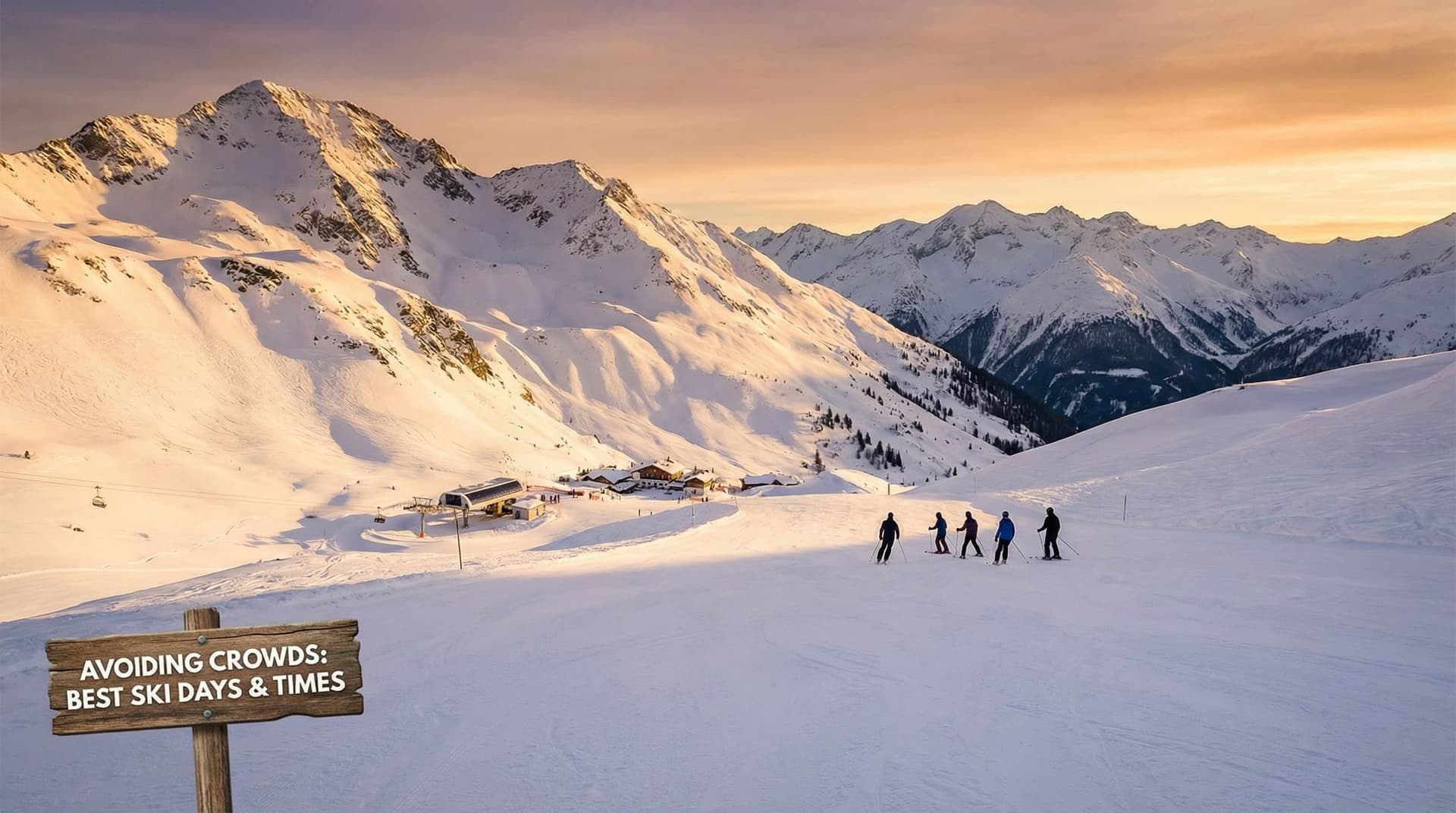
The difference between a great ski day and a miserable one often comes down to which day of the week you choose, not which resort. Peak season crowds aren't just an inconvenience; they're exhausting when you're managing young kids in ski boots. We're talking 45-minute lift queues at Vail on a Saturday in February, rental shops at Breckenridge hitting capacity by 8:30am, and cafeteria lines at lunch that eat 40 minutes out of your already-short ski window. Your kids hit their limit around 2pm on a good day, you cannot afford to burn two of those hours standing in line.
Here's what most families don't realize: the same mountain on a Tuesday feels like a completely different place. According to resort traffic data analyzed by ski industry researchers, weekday visitation at major Colorado resorts runs 30, 50% lower than weekend peaks, and mid-January through the first week of February, before President's Week, is consistently the least crowded stretch of the entire season. Meanwhile, the families fighting Saturday crowds in mid-February paid the same lift ticket price. Strategic timing isn't about luck; it's a learnable pattern that frequent skiers quietly exploit every season.
This guide breaks down exactly when to go, when to avoid, and how to structure your day on the mountain to sidestep the chaos at every stage, from the rental shop queue to the lunch rush to the afternoon lift pile-up. You'll get specific windows, specific days, and a few counterintuitive moves (like why a stormy forecast might be your best friend) that will make your family's ski trip feel half as stressful and twice as fun.
Best vs. Worst Days to Ski: A Quick Reference
| Day | Crowd Level | Avg. Lift Wait | Rental Shop | Your Verdict |
|---|---|---|---|---|
| Monday | Low | 5–10 min | Walk right in | ✅ Excellent, locals' secret |
| Tuesday | Low | 5–10 min | Walk right in | ✅ Best day on the mountain |
| Wednesday | Low–Medium | 10–15 min | Short wait | ✅ Sweet spot all week |
| Thursday | Medium | 15–20 min | Moderate | ⚠️ Fine, but crowds building |
| Friday | Medium–High | 20–35 min | Busy by noon | ⚠️ Go early or skip it |
| Saturday | High | 40–60 min | Plan 45 min ahead | ❌ Avoid if you can |
| Sunday | Medium–High | 25–40 min | Busy until 1pm | ⚠️ Better than Saturday, barely |
The Best Times of Day on the Mountain
The difference between a 45-minute lift line and a 4-minute one is often just two hours of sleep. Most skiers operate on the same instinct: wake up, grab breakfast, hit the slopes around 10am. That predictability is your advantage. Structure your day around the crowd wave instead of riding it, and you'll ski twice as many runs.
8, 9am: First Tracks, This is the golden hour, full stop. Lifts open (typically 8 or 8:30am at most North American resorts), the snow is freshest, and the day-trippers and families haven't arrived yet. Ski or ride the resort's highest-traffic runs, the groomers everyone wants, the mogul fields that get tracked out by noon, while they're empty. At a place like Park City or Vail, you can lap the same blue cruiser four times before the line hits double digits. Bring your own coffee in a thermos and skip the lodge entirely until the crowds force you in.
Mid-morning lull (9:30, 11:30am) once the early wave spreads across the mountain, lift lines on secondary chairs often drop to near nothing. This is the window to explore terrain you might otherwise skip, the far edges of the trail map, less obvious lifts, gladed runs that don't show up on Instagram. Use the resort's trail map app (most major resorts now publish live wait times) to find the chair with the shortest queue and work outward from there. You'll find pockets of untracked snow well into mid-morning if you're willing to move.
Noon, 2pm: Avoid the slopes and the lodge simultaneously. This sounds impossible, but it isn't, eat at 11am or after 2pm, and stay on the hill during the lunch rush. Lines drop noticeably when 30, 40% of skiers go inside to eat. If you can stomach a snack from your jacket pocket and keep skiing noon to 2, you're lapping terrain that felt inaccessible an hour ago. Then comes the late afternoon window (2, 4pm): families with young kids pack it in early, lesson groups wrap up, and the parking lot starts emptying. Snow is softer and more tracked out, but the mountain is quieter, and the light turns golden. Many resorts close chairs at 4 or 4:15pm, so check your specific mountain, but that final hour is often the most relaxed skiing of the day.
5 Peak Season Dates Families Should Avoid
Christmas Week (Dec 26, Jan 1)
Presidents' Week (Full Week, Mid-February)
Presidents' Day Weekend (Fri, Mon, ~Feb 14, 17)
Martin Luther King Weekend (Jan 18, 20, 2026)
Spring Break Peaks (Late March, Early April)
Your Low-Crowd Day Checklist
- Cross-reference school holiday calendars for your neighboring states, a Tuesday that's a regular school day in your state might be a holiday for the next state over, and those families are already on the road.
- Book midweek whenever possible. Wednesday is statistically the quietest day at most North American resorts, lift lines average 30, 50% shorter than Saturday, according to resort operations data.
- Arrive 20, 30 minutes before first chair. Parking lots fill fast and the first 90 minutes on fresh corduroy are magical, don't give that away to someone who set an alarm.
- Pre-load your ski rentals the night before. Most resorts let you complete paperwork and fittings the evening prior, saving 45, 60 minutes of your morning and skipping the 9am rental shop chaos entirely.
- Pack your own lunch. The lodge hits peak gridlock between 11:30am and 1:00pm, eating your own food on the mountain means you're making laps while everyone else is fighting for a table.
- Check the resort's real-time trail and lift app before you leave the house. Apps like OnTheSnow or the resort's own (Vail Resorts uses EpicMix, Alterra uses the Ikon Pass app) show live wait times, use them to reroute on the fly.
- Target runs two or more chairs away from the base area during mid-morning. The top and far edges of the trail map are where the crowd thins out fastest, most families default to runs directly above the lodge.
- Plan a deliberate 2:30, 3:30pm hot chocolate break. This is when lesson groups wrap up and afternoon skiers head home early, the slopes briefly quiet down and you get a second window of low-crowd runs before close.
- Avoid holiday weekends like Presidents' Day and Martin Luther King Jr. weekend entirely if you can, these are the two busiest ski weekends of the year at most U.S. resorts, with lift wait times often exceeding 45 minutes.
- Watch the forecast for storm days. A cold, snowy weekday keeps casual skiers home and rewards the committed, fresh snow mid-week is the closest thing to a secret weapon a ski family has.
How to Find Quiet Runs Even on Busy Days
The mountain doesn't get equally crowded everywhere, it gets crowded in predictable places, which means the solution is just knowing where not to be. On a busy Saturday, the runs funneling back to the main base lodge will be a parade. The fix is simple: ride up and stay up. Most day-trippers and beginners gravitate toward the bottom third of the mountain, so once you're above mid-station, the crowd thins dramatically. Commit to lapping from a top terminal rather than returning to the base between every run.
Pull out a trail map and look for lifts with unglamorous names, the ones that don't show up in resort marketing photos. A slow, older fixed-grip quad tucked on the side of the mountain is your friend. It loads fewer skiers per hour, attracts less attention, and often serves terrain that's equally good but out of the social media spotlight. Similarly, avoid any green runs that originate directly off the main base plaza, those are specifically designed for ski school traffic and first-timers finding their feet, and they'll feel like a school hallway at 3pm all day long.
The single most underused tactic: just ask someone who works the mountain. Ski patrol and ski school instructors have a real-time, granular read on where people are, and where they aren't. A quick "where's it quiet right now?" to a patroller at the top of a lift will get you a genuine, specific answer. They're not selling anything. Instructors are especially good sources because they actively route their groups away from congestion; the places they avoid with eight beginners in tow are exactly where you want to be.
- Go upper mountain first: Start your day by riding to the top immediately, don't warm up on easy base runs during peak load times (10am, noon).
- Target slow lifts: Fixed-grip triples and quads move fewer people per hour, so their associated runs stay quieter.
- Skip the green highway: Any wide, groomed green that feeds directly back to the main lodge will be congested by mid-morning.
- Ask at the top: Approach ski patrol or an instructor at the summit terminal, not the base, for the most current, useful advice.
Frequently Asked Questions
Is skiing on a holiday weekend ever worth it with kids?
Do resorts publish real-time crowd data?
What time do lift lines get longest?
Are smaller resorts less crowded during peak season?
Does bad weather actually reduce crowds enough to matter?
Get our free family ski trip checklist and one useful email a month.
Ready to Plan Your Trip?
Use our tools to find the perfect family ski resort.
More How-To Guides
Milan to Cortina With Kids: Complete Transportation Guide
Every option for getting from Milan to Cortina with children. Trains, buses, rental cars, and private transfers compared.
How-To GuidesThe Ultimate Family Ski Trip Checklist
Everything you need to pack for a stress-free family ski vacation, organized by timeline and age group.
How-To GuidesWhen to Book Your 2026-27 Family Ski Trip
A month-by-month booking timeline for the 2026-27 season, with the real pass deadlines, the 2027 school holiday collisions (English half-term splits across two weeks), and honest flags on what is reported versus confirmed.
Transparency note: This content was created with AI assistance and reviewed by Tom Meredith, our editor. Prices, dates, and availability may change. We recommend confirming details directly with the resort before booking.